



Introduction
Many patients with cancer turn to complementary and alternative medicine as an adjunct to their care. Historically, mushrooms have been used across various cultures for their health-promoting effects and for their effects on the immune system (Jin 2012). Much research has been conducted on the effects of mushrooms for various cancer types, including both laboratory research and clinical trials. The most common mushrooms that have been studied are Agaricus blazei, Coriolus versicolor, Grifolia frondosa, and Ganoderma lucidum. Agaricus has immunological effects on the complement and innate immune systems which could potentially lead to pro-apoptotic and anti-angiogenic effects (Lima 2011). Coriolus contains two polysaccharides (PSP and PSK) that appear to improve overall survival rates in patients with multiple cancers, including gastric, colon/ rectal, breast carcinomas (Wong 2012). Grifolia appears to stimulate the function of various immune cells and may improve overall quality of life, reduce tumor burden and act synergistically with chemotherapy, especially in patients with hepatocellular, breast and lung cancer (Kodama 2002). Ganoderma has the potential of reducing tumor burden and stimulating immunity in various cancer types (Jin 2012). This article will individually review the evidence available for these four mushrooms and clearly summarize the most pertinent research findings in the hopes that they can be effectively utilized in a clinical setting. Suggested dosing protocols and safety concerns are also explored for this purpose.
Agaricus blazei
Agaricus blazei is a medicinal mushroom of Brazilian origin. It has been used traditionally to treat a variety of conditions, including diabetes, hypercholesterolemia, chronic hepatitis and cancer (Hetland 2008). Agaricus contains several biologically active constituents, including beta-glucans, which are known activators of macrophages, polymorphonuclear cells and NK cells. The beta-glucans component of Agaricus blazei have been found to be the main source of antitumor activity (Hetland 2008).
More recent in-vitro and in-vivo evidence has demonstrated the immunological effects Agaricus blazei can have, via the complement and innate immune systems. A review paper of fourteen studies was recently published to assess Agaricus blazei’s action on the immune system (Lima 2011). In ten of the studies a stimulatory effect was observed, whereas in one study an inhibitory effect was described. In the remaining three studies, both effects were observed. The inhibitory effects included down-regulation of cytokines IL-2, IL-4, IFN-gamma and TNF-alpha. The stimulatory effects observed included stimulation of macrophages via CD receptors and of NK cells. Furthermore, in-vivo studies reviewed demonstrated a stimulatory effect of antibody synthesis and activation of the complement system. Thus Agaricus blazei’s mechanism of action includes acting as an anti-inflammatory agent, while stimulating both innate and adaptive immunity (Lima 2011).
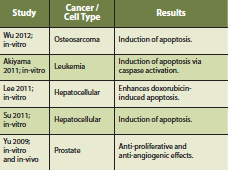
Furthermore, a phase I clinical study of Agaricus blazei was conducted on seventy-eight patients with a history of cancer who were in remission (Ohno 2011). Adverse events (AE’s) were observed in 12% of patients studied, with reports of nausea being the most common. Importantly, the authors make note that none of the AE’s occurred in a dose-dependent manner and that Agaricus blazei is considered safe in this patient population. Most of the anti-cancer research for Agaricus blazei consists of in-vitro and in-vivo studies. A pro-apoptotic effect has been observed in-vitro and whether this effect is maintained in human studies remains to be seen. Anti-angiogenic effects have also been studied in a rat model (Kimura 2004). Further human trials for Agaricus blazei are needed to fully understand its utility and safety.
Dosage: 1,500-3,000mg of hot-water extract daily, containing a minimum of 40% polysaccharides.
Safety: Caution with patients diagnosed with an autoimmune condition, and/or using immunosuppressive medications.
Coriolus versicolor (Trametes versicolor)
The mushroom Coriolus versicolor (Trametes versicolor) is a macrofungi belonging to the Basidiomycetes class, which consists of at least 22,000 known species (Chu 2002). Traditionally, it has been used to increase energy and treat pulmonary and upper respiratory tract infections, hepatitis and cancer. The fruiting body and mycelium provides its most effective components (Wong 2012).
Coriolus versicolor is one of the better-studied mushrooms …
Coriolus contains several different polysaccharides, however, most research has focused on polysaccharide peptide (PSP) and polysaccharide krestin (PSK) (Ng 1998). PSP and PSK are two chemically similar structures isolated from Coriolus versicolor from the mycelia of two different strains. Both extracts consist of similar compounds, with PSK predominantly containing fucose while PSP contains arabinose and rhamnose (Ng 1998). Coriolus versicolor is one of the better-studied mushrooms, with several randomized control trials. Most of the research is focused on quality of life outcomes and its use adjunctively with conventional cancer treatments. PSP and PSK are both used as interventions, however, PSK is more commonly used in randomized control trials.
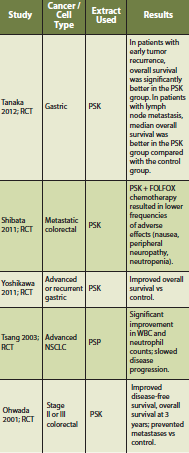 A systematic review and meta-analysis was conducted to assess the efficacy of Coriolus versicolor on overall survival in patients with cancer (Wong 2012). Thirteen randomized trials were included. Types of cancer (encompassing stage I to IV) in these studies included esophageal, gastric, colon/rectal, breast and nasopharyngeal carcinoma. All of the trials compared Coriolus versicolor with conventional cancer treatment versus conventional cancer treatment alone (with or without placebo). The dose range was 1-3.6g daily, and the duration of therapy was 1-36 months. In total, 1,284 patients with cancer were studied who received Coriolus versicolor versus 1,303 in the conventional cancer treatment group. There was a statistically significant difference in overall survival at 5 year (P < 0.00001; RR = 1.14 95% CI = 1.09, 1.20). AE’s were not significantly increased as a result of Coriolus versicolor intervention. Of patients randomized to Coriolus versicolor, there was a 9% absolute reduction in 5-year mortality, resulting in one additional patient alive for every 11 patients treated. The authors state that in patients with breast, gastric, or colorectal cancer treated with conventional cancer treatments and Coriolus versicolor, the overall 5-year survival rate was more profound (Wong 2012).
Dosage: 3,000-6,000 mg of hot-water extract daily, containing a minimum of 20-40% beta-glucans.
Safety: Caution with patients diagnosed with an autoimmune condition, and/or using immunosuppressive medications.
Maitake (Grifola frondosa)
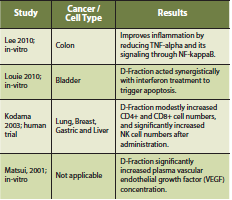
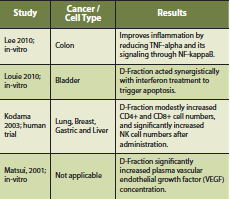
Maitake mushroom consists of a beta-glucan termed D-Fraction, which is extracted from the fruiting body (Kodama 2003). D-Fraction has been found to stimulate the function of immune cells such as macrophages, helper T cells, cytotoxic T cells and NK cells (Kodama 2003). Case series reports and clinical trials have reported an immune-stimulatory effect from Maitake mushroom, showing an increase in CD4+ cell count after administration (Kodama 2002). Furthermore, Maitake may improve overall quality of life, reduce tumor burden and act synergistically with chemotherapy. These effects were most profound in patients with hepatocellular, breast and lung cancer (Kodama 2002).
A phase I/II clinical study of Maitake mushroom was conducted on thirty-four postmenopausal breast cancer patients, free of disease after initial treatment, to detect immunological effects (Deng 2009). The authors state that no dose-limiting toxicity was encountered and that there appears to be no ‘maximum dose’, only ‘optimal dose’ depending on the immunological outcome desired. Some of the parameters measured increased with an increasing Maitake dose (CD4+ and CD8+ cells), whereas others were highest at an intermediate dose of Maitake (IL-10, IL-2, TNF-alpha) (Deng 2009).
There is a complex interaction of Maitake mushroom with the innate and adaptive immune system. Depending on the dose, there can be specific immune stimulatory and/or immune suppressing effects. Preliminary evidence also suggests that intravenous vitamin C may act synergistically with Maitake D-Fraction to improve conventional cancer treatments (Konno 2009).
Dosage: 500-3,000 mg of hot-water extract daily, containing a minimum of 20% polysaccharides.
Safety: Caution with patients diagnosed with an autoimmune condition, and/or using immunosuppressive medications.
Reishi (Ganoderma lucidum)
Ganoderma lucidum has been used to treat a variety of conditions for centuries in China, Korea and Japan (Sliva 2003). Traditionally, it has been used to treat hypertension, hyperlipidemia, viral infections, cardiovascular disease, asthma and cancer (Sliva 2003). The direct cytotoxic and anti-angiogenesis mechanisms of Ganoderma lucidum have been reproducibly demonstrated by in-vitro studies (Yuen 2005). Human clinical studies are required in order to better establish proper dosing and define the full range of activity of Ganoderma lucidum and its mechanisms of actions. The evidence available is conflicting and there are specific safety concerns with Ganoderma.
A recent Cochrane review did not find sufficient evidence to justify the use of Ganoderma lucidum as a first-line treatment for cancer (Jin 2012). However, the authors state that there is sufficient evidence to consider Ganoderma lucidum as an adjunctive treatment to conventional cancer therapies due to its potential of reducing tumor burden and stimulating immunity. Importantly, no major toxicity was noted in the studies reviewed with only a few reports of minor adverse events.
There is concern that Ganoderma lucidum may inhibit platelet aggregation and is a relative contraindication for patients on antiplatelet medication (Tao 1990). Evidence is currently conflicting, with studies stating that at doses of 1.5g Ganoderma lucidum does not impair hemostatic function and increase risk of bleeding (Kwok 2005). However, at higher doses hemostatic function may be impaired and currently, caution is advised.
Dosage: 1000-4000 mg of hot water extract daily, containing a minimum of 10% polysaccharides.
Safety: Caution with patients diagnosed with an autoimmune condition, and/or using immunosuppressive medications. Caution is also advised for patients on concomitant hypotensive and/ or antiplatelet therapy.
Conclusion
Many patients with cancer use complementary and alternative medicine as an adjunct to their care, including the use of mushrooms. Many immunological mechanisms were described. In terms of outcomes, Agaricus was shown to induce apoptosis in a number of cancer types. In clinical trials of patients with remission, it had a good safety profile with a limited number of AE’s (Ohno 2011). Coriolus is the most well-studied mushroom and in studies of 5 cancer types showed a 9% absolute reduction in 5-year mortality, resulting in one additional patient alive for every 11 patients treated (Wong 2012). Grifolia was shown to stimulate various immune cells, but had limited data with regards to patient outcomes. Ganoderma had some conflicting evidence regarding its clinical effects and had potential safety concerns due to the potential inhibition of platelet aggregation (Kwok 2005). Overall, mushrooms should be used in doses of 500-6,000mg per day, with some variation based on the specific mushroom. Additional precautions should be taken in patients diagnosed with an autoimmune condition or using immunosuppressive medications. The evidence supports the use of mushrooms as clinically useful adjuncts to conventional cancer care, especially Coriolus versicolor.
References
Akiyama H, Endo M, Matsui T, Katsuda I, Emi N, Kawamoto Y, Koike T, Beppu H. Agaritine from Agaricus blazei Murill induces apoptosis in the leukemic cell line U937. Biochem Biophys Acta. 2011 May;1810(5):519-25.
Chu K, Ho S, Chow A. Coriolus versicolor: A Medicinal Mushroom with Promising Immunotherapeutic Values. Journal of Clinical Pharmacology. 2002;42:976-984.
Deng G, Lin H, Seidman A, Fornier M, D’Andrea G, Wesa K, Yeung S, Cunningham- Rundles-S, Vickers A, Cassileth B. A phase I/ II trial of a polysaccharide extract from Grifola frondosa (Maitake mushroom) in breast cancer patients: immunological effects. J Cancer Res Clin Oncol. 2009;135:1215-1221.
Hetland G, Johnson E, Lyberg T, Bernardshaw S, Tryggestad A, Grinde B. Effects of the Medicinal Mushroom Agaricus blazei Murill on Immunity, Infection and Cancer. Scandinavian Journal of Immunology. 2008 July;68:363-370.
Jin X, Ruiz J, Sze DMY, Chan GCF. Ganoderma lucidum (Reishi mushroom) for cancer treatment (Review). The Cochrane Collaboration. 2012;6:1-38.
Kimura Y, Kido T, Takaku T, Sumiyoshi M, Baba K. Isolation of an anti-angiogenic substance from Agaricus blazei Murill: its antitumor and antimetastatic actions. Cancer Sci. 2004 Sept;95(9):758-64.
Kodama N, Komuta K, Nanba H. Can Maitake MD-Fraction Aid Cancer Patients? Alternative Medicine Review. 2002;7(3):236-9.
Kodama N, Komuta K, Nanba H. Effect of Maitake (Grifola frondosa) D-Fraction on the Activation of NK cells in Cancer Patients. J Med Food. 2003;6(4):371-77.
Konno S. Synergistic potentiation of D-Fraction with vitamin C as possible alternative approach for cancer therapy. Int J Gen Med. 2009 Jul;2:91-108.
Kwok Y, Ng K, Li C, Lam C, Man R. A Prospective, Randomized, Double-Blind, Placebo Controlled Study of the Platelet and Global Hemostatic Effects of Ganoderma lucidum (Ling-Zhi) in Healthy Volunteers. Anesth Analg. 2005;101:423-6.
Lee JS, Hong EK. Agaricus blazei Murill enhances doxorubicin-induced apoptosis in human hepatocellular carcinoma cells by NFkB-mediated increase of intracellular doxorubicin accumulation. Int J Oncol. 2011 Feb;38(2):401-8.
Lee JS, Park SY, Thapa D, Choi MK, Chung IM, Park YJ, Yong CS, Choi HG, Kim JA. Grifola frondosa water extract alleviates intestinal inflammation by suppressing TNF-alpha production and its signaling. Exp Mol Med. 2010 Feb;42(2):143-54.
Lima C, Cordova C, Nobrega O, Funghetto S, Karnikowski M. Does the Agaricus blazei Murill Mushroom Have Properties That Affect the Immune System? An Integrative Review. Journal of Medicinal Food. 2011 March;14(1/2):2-8.
Louie B, Rajamahanty S, Won J, Choudhury M, Konno S. Synergistic potentiation of interferon activity with maitake mushroom d-fraction on bladder cancer cells. BJU Int. 2010 Apr;105(7):1011-5.
Martinez-Montemayor MM, Acevedo RR, Otero-Franqui E, Cubano LA, Dharmawardhane SF. Ganoderma lucidum (Reishi) inhibits cancer cell growth and expression of key molecules in inflammatory breast cancer. Nutr Cancer. 2011;63(7):1085-94.
Matsui K, Kodama N, Nanba, H. Effects of maitake (Grifola frondosa) D-Fraction on the carcinoma angiogenesis. Cancer Lett. 2001 Oct;172(2):193-8.
Ng T. A Review of Research on the Protein-Bound Polysaccharide (Polysaccharide, PSP) from the Mushroom Coriolus versicolor (Basidiomycetes: Polyporaceae). Gen. Pharmac. 1998;30(1):1-4.
Ohno S, Sumiyoshi Y, Hashine K, Shirato A, Kyo S, Inoue M. Phase I Clinical Study of the Dietary Supplement, Agaricus blazei Murill, in Cancer Patients in Remission. Evid Based Complement Alternat Med. 2011.
Ohwada S, Kawate S, Ikeya T, Yokomori T, Kusaba T, Roppongi T, Takahashi T, Nakamura S, Kawashima Y, Nakajima T, Morishita Y. Adjuvant Therapy With Protein-Bound Polysaccharide K and Tegafur Uracil in Patients with Stage II or II Colorectal Cancer: Randomized, Controlled Trial. Dis Colon Rectum. 2003 Aug;46(8):1060-8.
Oka S, Tanaka S, Yoshida S, Hiyama T, Ueno Y, Ito M, Kitadai Y, Yoshihara M, Chayama K. A water-soluble extract from culture medium of Ganoderma lucidum mycelia suppresses the development of colorectal adenomas. Hiroshima J Med Sci. 2010 Mar;59(1):1-6.
Shibata M, Shimura T, Nishina Y, Gonda K, Matsuo S, Abe H, Yajima Y, Nakamura I, Ohki S, Takenoshita S. PSK decreased FOLFOX4-induced peripheral neuropathy and bone marrow suppression in patients with metastatic colorectal cancer. Gan To Kagaku Ryoho. 2011 May;38(5):797-801.
Sliva D. Ganoderma lucidum (Reishi) in Cancer Treatment. Int Cancer Therapies. 2003;2(4):358-364.
Su ZY, Tung YC, Hwang LS, Sheen LY. Blazeispirol A from Agaricus blazei fermentation product induces cell death in human hepatoma Hep 3B cells through caspase-dependent and caspase-independent pathways. J Agric Food Chem. 2011 May;59(9):5109-16.
Tanaka H, Muguruma K, Ohira M, Kubo N, Yamashita Y, Maeda K, Sawada T, Hirakawa K. Impact of adjuvant immunochemotherapy using protein-bound polysaccharide-K on overall survival of patients with gastric cancer. Anticancer Res. 2012 Aug;32(8):3427-33.
Tao J, Feng KY. Experimental and clinical studies on inhibitory effect of ganoderma lucidum on platelet aggregation. J Tongji Med Univ. 1990;10:240-3.
Thyagarajan A, Zhu J, Sliva D. Combined effect of green tea and Ganoderma lucidum on invasive behavior of breast cancer cells. Int J Oncol. 2007 Apr;30(4):963-9.
Tsang KW, Lam CL, Mak JC, Ooi GC, Ho JC, Lam B, Man R, Shan JS, Lam WK. Coriolus versicolor polysaccharide peptide slows progression of advanced non-small cell lung cancer. Respir Med. 2003 Jun;97(6):618-24.
Weng CJ, Chau CF, Yen GC, Liao JW, Chen DH, Chen KD. Inhibitory effects of ganoderma lucidum on tumorigenesis and metastasis of human hepatoma cells in cells and animal models. J Agric Food Chem. 2009 Jun;57(11):5049-57.
Wong E, Fai C, Chung L. Efficacy of Yun Zhi (Coriolus versicolor) on Survival in Cancer Patients: Systematic Review and Meta-Analysis. Recent Patents on Inflammation and Allergy Drug Discovery. 2012;6:78-87.
Wu B, Cui J, Zhang C, Li Z. A polysaccharide from Agaricus blazei inhibits proliferation and promotes apoptosis of osteosarcoma cells. Int J Biol Macromol. 2012 May; 50(4): 1116-20.
Yoshikawa T, Tsuburaya A, Saze Z, Aoyama T, Hasegawa S, Kanemoto A, Terashima M, Tahara H. Randomized phase II trial to compare S-1 and S-1/PSK for advanced or recurrent gastric cancer-lessons from the results. Gan To Kagaku Ryoho. 2011 Nov;38(12):1909-11.
Yu CH, Kan SF, Shu CH, Lu TJ, Sun-Hwang L, Wang PS. Inhibitory mechanisms of Agaricus blazei Murill on the growth of prostate cancer in vitro and in vivo. J Nutr Biochem. 2009 Oct; 20(10):753-64.
Yuen J, Gohel M. Anticancer Effects of Ganoderma lucidum: A Review of Scientific Evidence. Nutrition and Cancer. 2005;53(1):11-17.
Zhao S, Ye G, Fu G, Cheng JX, Yang BB, Peng C. Ganoderma lucidum exerts anti-tumor effects on ovarian cancer cells and enhances their sensitivity to cisplatin. Int J Oncol. 2011 May;38(5):1319-27