



Canada’s largest grocer revives its tariff shelf symbol as 50 per cent counter-tariffs land on whey protein, honey and personal care in the middle of a global protein shortage. Finished supplements stay off the list.
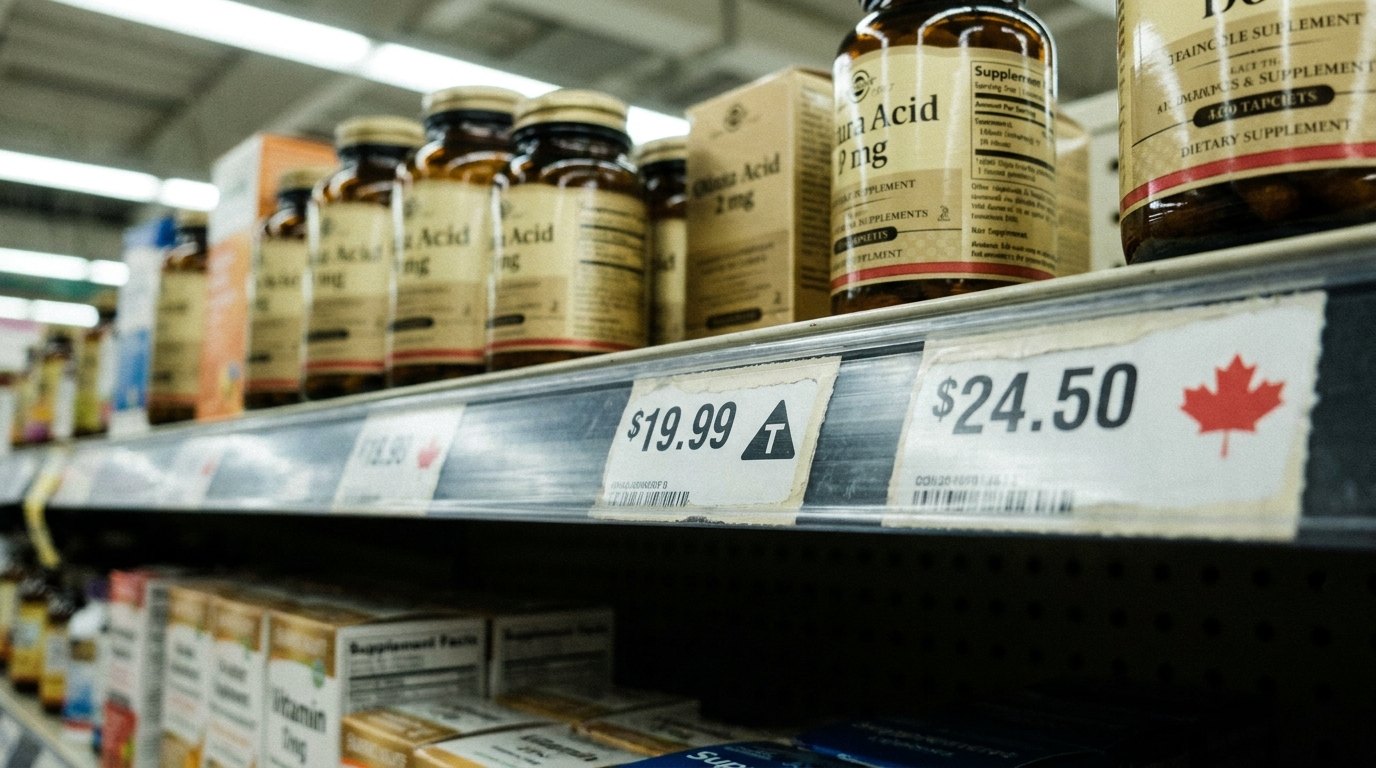
What is the T symbol? It is a triangle-shaped shelf tag with a “T” inside that Loblaw places beside products whose prices have risen because of tariffs. First introduced in March 2025 and retired as tensions cooled, it returns to Loblaws, No Frills, Real Canadian Superstore and Shoppers Drug Mart on September 8, 2026, the day Canada’s newest counter-tariffs take effect.
Key takeaways
- Loblaw restores tariff labels, maple leaf marks and country-of-origin produce signage across its banners on September 8, including at Shoppers Drug Mart, where they will appear in the vitamin and beauty aisles.
- Ottawa’s counter-tariffs answer Washington’s new duties with surtaxes of 15 to 50 per cent on close to $20 billion in U.S. imports.
- Whey protein, casein and milk albumin take the top rate while high-protein whey is already up 162 per cent since early 2025 and U.S. suppliers are sold out for the year.
- Honey is now tariffed in both directions; so is much of the beauty and personal care aisle.
- Finished vitamins, supplements, essential oils and soap are absent from the list, a carve-out that spares most of the NHP shelf.
Trade talks between Ottawa and Washington collapsed on August 21. Within days, a 50 per cent American tariff was in force on roughly $20 billion of Canadian goods, about five per cent of everything Canada sells into its largest market, and the list ignored protections that CUSMA-compliant products had carried through earlier rounds. “You’re at war when you get attacked. We got attacked,” Prime Minister Mark Carney said. On August 25, Canada answered dollar for dollar: surtaxes of 15, 25 and 50 per cent on hundreds of U.S. tariff lines effective September 8, plus a $7.5-billion support package for affected workers and businesses.
One day later, Loblaw told customers the T symbol was coming back.
By the numbers
- 50 per cent — the U.S. tariff on roughly $20 billion of Canadian goods, in force since late August (PBS NewsHour)
- 15, 25 and 50 per cent — Canada’s counter-tariff rates on close to $20 billion of U.S. imports, effective September 8 (Finance Canada)
- 162 per cent — the rise in high-protein whey prices since the start of 2025, before any surtax applies
- US$200 million+ — Canadian protein exports covered by the new American duties
- 70 per cent — the share of Canadians who prioritize locally made or sourced products (CHFA research)
- Under 4 per cent — Canadian vitamin and supplement category growth in 2026, per the market leader’s own read
Penny for penny, with Shoppers in the frame
Loblaw’s playbook mirrors spring 2025: the triangle-T wherever tariffs push up cost, the maple leaf beside Canadian-made goods, and country-of-origin labels restored in fresh produce. CEO Per Bank has promised exact pass-through: “Where tariffs increase our cost, any resulting increase on our shelves will reflect that impact — penny for penny.” He says a year of shifting sourcing from the United States to Canada leaves the company better prepared than last time.
The detail that matters most to this readership is the banner list. Shoppers Drug Mart carries the labels too, which puts tariff transparency directly beside the supplement and natural beauty sets of the country’s biggest pharmacy chain and will shape how mainstream shoppers interpret price moves in categories independents also sell.
Competitors are choosing celebration over warning. Empire’s Sobeys banners are expanding signage that pairs local products with provincial flags; Metro says it already prioritizes Canadian products and will lean harder into that positioning. Independents got there first. Winnipeg grocer Foodfare has been running “Made in Canada” shelf stickers and giving domestic lines priority placement. “We’re always looking at different products and making sure that those ones that are made right here in Canada are highlighted first, and given more shelf space,” says owner Ramsey Zeid. Retail analysts expect the renewed Buy Canadian wave to lift sales quickly but unevenly: Kantar’s Amar Singh predicts the surge will concentrate among affluent shoppers, and the first wave had largely faded by November 2025 after food inflation wore consumers down.
Where the counter-tariff list touches the industry
The September 8 schedule published by Finance Canada reads, at first glance, like a grocery and hardware story: dairy, cheese, paper, appliances, steel. Look closer and several lines land squarely on the natural health cost base.
Dairy proteins, 50 per cent. Whey and whey protein concentrates (HS 0404), casein and its derivatives (3501.10), milk albumin (3502.20) and milk protein substances (3504) all take the top rate when U.S.-origin.
Sweeteners. Natural honey (0409) and cane molasses (1703), both health food staples, carry the full 50 per cent rate.
Personal care. Perfumes and toilet waters (3303), lip, eye and manicure preparations (3304) and most hair preparations (3305.90) are surtaxed at the same top rate, catching a meaningful share of U.S. beauty and grooming assortments.
Packaging, 25 to 50 per cent. Corrugated cartons at 50 per cent, kraft papers at 25 to 50 per cent and tissue at 25 per cent will feed into freight and private-label costs even for stores that stock no American product at all.
Just as important is what is absent. Vitamins and provitamins (HS 2936), food preparations and finished supplements (2106), medicaments (Chapter 30), essential oils (3301), soap (3401) and oral care (3306) do not appear. Finished natural health products from U.S. suppliers cross the border surtax-free, a carve-out that looks deliberate in a schedule this aggressive, and one that spares the core NHP shelf a direct price shock.
The protein squeeze is the real story
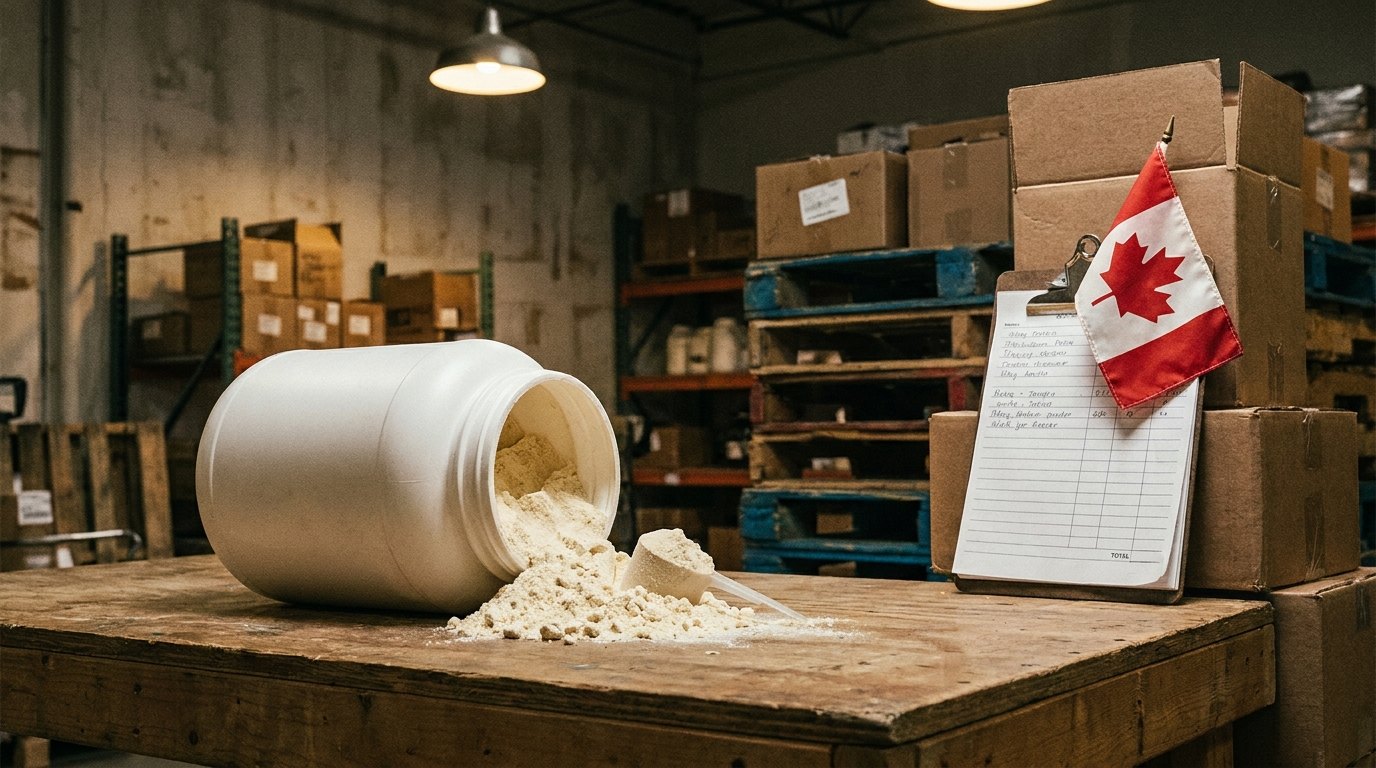
For sports nutrition, the surtax could hardly come at a worse moment. High-protein whey prices have climbed 162 per cent since the start of 2025, driven by a demand boom that has put more than 38,000 protein-claiming products on U.S. supermarket shelves and been amplified by users of GLP-1 weight-loss drugs seeking to preserve muscle. American whey suppliers are reported to be sold out for the remainder of 2026, and production cannot simply scale up: whey is a byproduct of cheesemaking, and as the University of Guelph’s Hrvoje Fabek notes, expanding it means flooding the cheese market.
The trade war squeezes Canadian players from both ends. Washington’s duties cover more than US$200 million in Canadian protein exports, hitting processors such as Agropur, Saputo and Lactalis Canada. Alberta-based formulator HelloAmino reports a 50 per cent jump in dairy protein costs and months of failed attempts to secure whey supply; “Literally no one wants to do business with us,” CEO Aelie Swift told reporters this spring. Now U.S.-origin whey coming north carries a 50 per cent surtax on top of shortage pricing. Retailers should expect protein powder cost letters within weeks, more aggressive reformulation toward plant proteins, and a widening price gap between brands blending Canadian or European dairy inputs and those locked into American supply.
Honey and beauty, hit from both directions
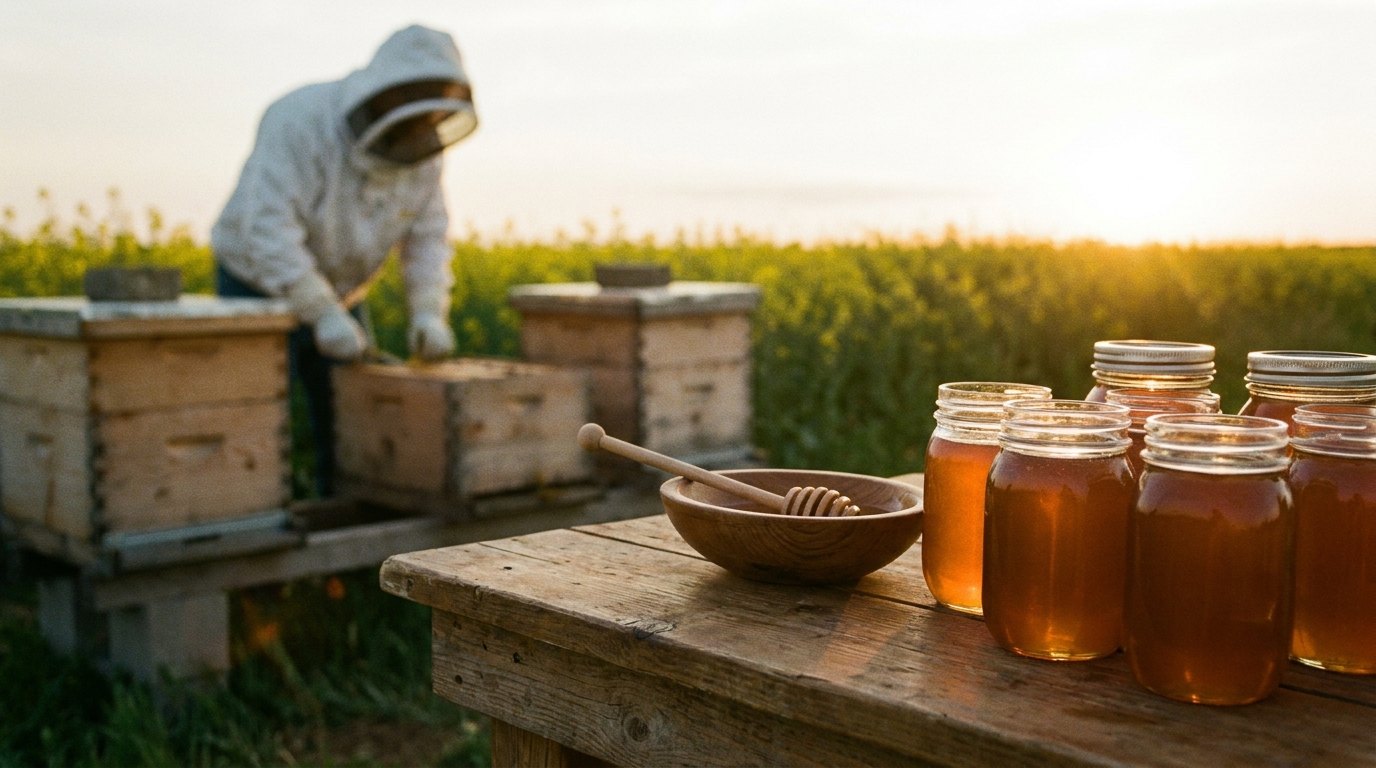
Honey occupies the strangest position in this dispute. The U.S. duty on Canadian honey was announced on July 20 under Section 338 of the Tariff Act of 1930, tucked, oddly, into an annex nominally about motor vehicles, and the Canadian Honey Council was blunt about the logic.
“Honey is not a source of irritation. They are just trying to hit as provocative and impactful a list as possible.”
— Jake Berg, chair, Canadian Honey Council
With Canada’s mirror surtax on American honey effective September 8, the product is now tariffed in both directions: Canadian beekeepers lose margin on exports south while U.S. jars on Canadian shelves get more expensive. For retailers, local honey programs just became both easier to justify and easier to market.
Natural beauty faces the same two-way exposure. The American list explicitly covers cosmetics and toiletries, walling off the U.S. market for Canadian personal care exporters, including goods CUSMA once protected, while Ottawa’s surtaxes raise the cost of U.S. makeup, fragrance and hair care sold here. Canadian-made body care lines gain a pricing advantage on domestic shelves at precisely the moment shoppers are primed to look for the maple leaf.
The domestic industry’s hand
The sector meets this moment with real vulnerabilities. More than 80 per cent of natural, organic and wellness businesses are small or medium-sized, with thin capacity to absorb cost shocks, and the Canadian Health Food Association has long warned about dependence on U.S. intermediaries: vitamin K2 has no North American manufacturer, Korean ginseng mostly transits American brokers, and 80 to 85 per cent of Canada’s psyllium arrives the same way. Broker-routed ingredients may escape the surtax on paper, since origin, not routing, determines liability, but they remain exposed to freight, currency and a chaotic U.S. wholesale market.
It also meets the moment with genuine advantages. CHFA research has found 70 per cent of Canadians prioritize locally made or sourced products, and manufacturers with domestic plants are structurally insulated; Jamieson Wellness, for one, makes nearly everything it sells in Canada in Canada, and where a supplier’s plant sits has become a commercial variable rather than a procurement footnote. The timing matters because the domestic category needs the help: the market leader pegged Canadian vitamin and supplement growth at under four per cent this year. A patriotic demand wave, however temporary, is the strongest tailwind the category has seen in some time, and it favours whoever can prove Canadian origin at the shelf.
Why this matters for the trade
The window before September 8 is short. Confirm country of origin and HS classification on every U.S.-sourced SKU in protein, honey, molasses and personal care rather than waiting for supplier cost letters. Review packaging contracts, where the surtax will arrive quietly. Choose a signage position (tariff transparency, Canadian celebration, or both) before the chains define shopper expectations for everyone. Above all, treat origin as merchandising: the stores that won the first Buy Canadian wave were the ones whose shelves made the patriotic choice effortless, and this wave arrives with a protein shortage and a honey standoff pushing in the same direction.
Frequently Asked Questions
What is the Loblaw T symbol? It is a triangle-shaped “T” printed on shelf tags to flag products whose prices rose because of tariffs. Loblaw introduced it in March 2025 and is reinstating it on September 8, 2026 across Loblaws, No Frills, Real Canadian Superstore and Shoppers Drug Mart, alongside maple leaf tags on Canadian-made goods.
Are vitamins and supplements on Canada’s counter-tariff list? No. Finished supplements (HS 2106), vitamins and provitamins (HS 2936), medicaments, essential oils, soap and oral care are all absent from the September 8 schedule, so finished U.S. natural health products enter Canada without a surtax. Freight, currency and supplier pricing pressures still apply.
Which natural health categories are hit hardest by the counter-tariffs? U.S.-origin whey protein, casein, milk albumin and milk protein substances carry a 50 per cent surtax, as do natural honey, molasses, perfumes, makeup preparations and most hair care. Corrugated packaging is surtaxed at 50 per cent and kraft papers at 25 to 50 per cent, raising costs for everyone.
Why are protein powder prices rising so fast? A global whey shortage predates the tariffs: high-protein whey has climbed 162 per cent since early 2025 on demand from GLP-1 users and protein-fortified foods, and U.S. suppliers are reportedly sold out for 2026. The new 50 per cent surtax on U.S.-origin whey stacks on top of that shortage pricing.
How is honey affected by the trade war? Both ways. Washington put a 50 per cent duty on Canadian honey in a move the Canadian Honey Council called deliberately provocative, and Ottawa’s September 8 counter-tariffs apply the same rate to U.S. honey entering Canada. Local honey programs now carry both a margin and a marketing advantage.
How should independent health food stores respond? Audit U.S.-sourced SKUs in protein, honey and personal care before September 8, verify origin claims with suppliers, review packaging costs, and invest in Canadian-origin signage. Stores with strong domestic assortments are best placed to capture the renewed Buy Canadian demand.
Sources
- Finance Canada — counter-tariff list effective September 8, 2026
- CP24 / The Canadian Press — Loblaw bringing back T symbols
- Canadian Grocer — Loblaw reinstates ‘T’ symbol
- BNN Bloomberg — ‘Buy Canadian’: local grocers label domestic products
- PBS NewsHour — Trump’s 50% tariffs on Canadian goods
- NPR — Canada hits back with tariffs
- The Canadian Vanguard — U.S. tariffs on Canadian whey
- Canadian Honey Council — Tariffs 2026
- Canadian Grocer — NHP sector braces for U.S. tariffs
- Grocery Business — Tariffs and the natural health products industry
IHR Magazine is Canada’s trade publication for the natural health, personal care and nutraceutical industry, covering the retailers, brands and policy shifts that shape the market.