




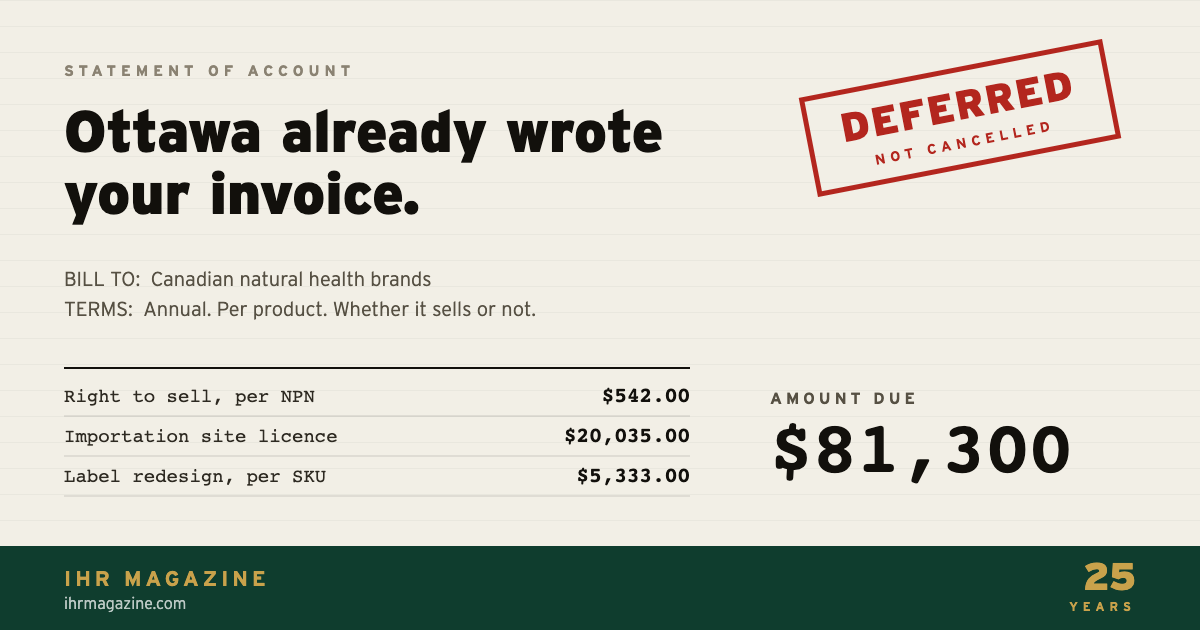
Five hundred and forty-two dollars. That is the annual fee Health Canada proposed for the right to keep one natural health product on the market, per NPN, every year, whether the product moves or not. A brand carrying 150 licences would owe $81,300 before manufacturing a single bottle, or $60,975 after the small-business reduction. The fee is not in force. It has also never been withdrawn.
Hold that number. It measures a shift the trade keeps getting backwards, because nobody here is deregulating anything. Ottawa has deferred an invoice it already wrote and costed. Washington, moving the other way, is assembling pre-market machinery on top of a mechanism that has spent thirty years turning most applicants away. The two markets are swapping seats, and what follows is what that costs a Canadian catalogue.
IHR Magazine · Figure 1
What the right-to-sell fee costs a catalogue
Annual cost of Health Canada’s proposed $542 per-NPN right-to-sell fee, by number of live licences. Site licence and evaluation fees are additional. The fee is proposed and not currently in force.
Small-business rate (25% reduction)
Source: Health Canada, revised proposed fees for natural health products, March 2024. Chart: IHR Magazine. Small-business rate applies to firms with fewer than 100 employees or $30,000 to $5 million in annual revenue.
View as table
| Live NPNs | Standard rate | Small-business rate |
|---|
The bill Ottawa deferred
The 2022 amendments to the Natural Health Products Regulations get discussed as a design problem. Read the costing and they turn into a capital problem. Health Canada’s own impact analysis put the average label redesign at $5,333 per SKU. Roughly 50,000 SKUs are affected, held by slightly more than 4,000 licence holders, and the department totalled the sector’s bill at $158.7 million in present value over fifteen years.
Industry never accepted those numbers. One in five brands told the Canadian Health Food Association they were seriously considering leaving the Canadian market over regulatory cost. That is not the answer you get to $17,550 spread across fifteen years, which is what the department calculated the average small business would pay. Someone’s arithmetic is wrong, and the unresolved gap between the two is the real reason the date keeps sliding.
Slide it has. A ministerial exemption order signed March 7, 2025 lifted newly licensed products out of their June 2025 obligation and swept the whole catalogue to June 21, 2028. Health Canada has since signalled a further extension, with revised amendments now targeted for Canada Gazette, Part I in spring 2027. Six years after the rules were written, no brand in this country can tell a packaging supplier when to book press time.
The fee file is where the real money sits
Labelling is the headline. Cost recovery is the balance sheet. The revised March 2024 schedule proposed $542 annually per NPN for the right to sell, plus annual site fees of $20,035 for importation, $23,071 for non-sterile manufacturing and $7,650 for packaging. Pre-market evaluation ran from $1,124 for a Class I submission to $58,332 for a Class III novel.
Read the importation line again. Twenty thousand a year, per site, simply to be the party bringing product across the border. That fee was drafted for a world without counter-tariffs. It now queues behind them. Since September 8, 2026, Canada has applied surtaxes of 15, 25 and 50 per cent across $27.6 billion of US imports, with personal care in the top band. Anyone distributing American lines is looking at a tariffed cost base, a fee regime idling offstage, and a labelling deadline nobody will put in writing.
Final fees must clear Canada Gazette, Part II before they bite, which is why the file reads as paused rather than dead. Budgeting on that distinction is budgeting on a technicality.
Washington is building a door it has rarely opened
The FDA named supplements in its 2026 Human Foods Program priorities back in January, promising final new dietary ingredient guidance and a look at modernized oversight. By March it had convened a public meeting on what should even count as a dietary ingredient, with precision fermentation and cell culture forcing the question. A proposed rule scheduled for December would make GRAS notices mandatory for new substances, closing thirty years of self-affirmation.
The track record is the part worth studying before you source another American ingredient. The NDI pathway, closest US analogue to Canadian pre-market review, has taken 1,166 notifications since 1995 and acknowledged 36.5 per cent of them without objection, a rate that sank to 12.6 per cent in fiscal 2017. Two-thirds of the ingredients that bother to knock get an objection letter. That is the filter, in a market Senator Dick Durbin puts at roughly 100,000 products against about 4,000 when DSHEA passed.
Nobody should read this as America turning into Canada. What it is turning into is harder to plan around, because the pressure now arrives through courts and state legislatures rather than the Federal Register. New York’s marketing-based age restriction on weight-loss and muscle-building products survived the Second Circuit in November 2025; CRN took it to the Supreme Court in March. The FTC sued Amare Global in June. None of that surfaces in a rulemaking search before a buyer lists a line.
Why the NPN starts looking like an asset
Canadian operators have spent twenty years treating the Natural Product Number as a tax. On this trajectory it becomes a credential. An NPN file is documented safety, quality and evidence work that US retail diligence teams increasingly ask for and US suppliers often cannot produce. Put plainly: a brand with clean monograph files sits closer to a national vendor review than a competitor with a better label and no dossier behind it.
Retailers get caught on the reverse trade. A longer Canadian runway buys relief on artwork and none at all on language, since claims here are bounded by what the NPN authorizes, and structure-function copy that passes unchallenged in Ohio is not licensed in Ontario. No public figure exists for how much of the Canadian natural health shelf is US-origin. That is a gap this industry should be embarrassed by, though any buyer can measure their own exposure in an afternoon.
Our view
The pause is the worst available outcome for a serious operator. A hard 2028 deadline would have forced the SKU rationalisation this industry has needed for a decade: catalogues costed, the tail cut, the savings redirected into evidence. Instead the cost sits on the books with no date attached, and the discipline never arrives.
Deferral is a subsidy, and it flows to the wrong operators. The heaviest relative burden falls on brands that licensed properly and invested in substantiation. They now compete against companies betting the rules never land at all, and Ottawa has effectively backed the bet.
What IHR is tracking next
Three dates decide how this ends. December 2026, when the FDA’s mandatory GRAS proposal is scheduled. Spring 2027, when Health Canada’s revised labelling amendments are due in Canada Gazette, Part I. And the Supreme Court’s call on the New York case, which tells brands whether marketing-based sales restrictions travel past one state.
IHR will publish the costed read on each within the week it lands, and the fee and deadline figures above are maintained in our regulatory cost tracker, updated whenever the Gazette moves. Until then the arithmetic is the assignment: live NPN count times $542, in front of whoever approves the catalogue, before the next reset order goes in.
IHR Magazine · Regulation & Compliance
Regulatory Cost & Deadline Tracker: Canada and the US
Every proposed fee, confirmed deadline and pending decision that changes what a Canadian natural health catalogue costs to carry. Maintained by IHR and updated whenever the Canada Gazette or the Federal Register moves.
Last updated 1 September 2026
What your catalogue would cost
Enter your live NPN count. Based on Health Canada’s proposed $542 annual right-to-sell fee, at the standard rate and with the 25 per cent small-business reduction.
Right-to-sell fees only. Site licence and evaluation fees are additional. These amounts are proposed and not currently in force.
Canada: proposed fees (paused, not withdrawn)
| Fee | Amount | Basis | Status |
|---|---|---|---|
| Right to sell | $542 | Per NPN, annual | Paused |
| Site licence: importation | $20,035 | Per site, annual | Paused |
| Site licence: manufacturing (non-sterile) | $23,071 | Per site, annual | Paused |
| Site licence: packaging | $7,650 | Per site, annual | Paused |
| Pre-market evaluation, Class I | $1,124 | Per submission | Paused |
| Pre-market evaluation, Class III | $7,209 | Per submission | Paused |
| Pre-market evaluation, Class III novel | $58,332 | Per submission | Paused |
| Small-business relief | 100 / 50 / 25% | First evaluation waived, 50% after, 25% off site and right-to-sell | Paused |
Dates that decide the next two years
| Date | What happens | Market | Status |
|---|---|---|---|
| 8 Sep 2026 | Counter-tariffs of 15, 25 and 50% across $27.6B of US imports | Canada | In force |
| Dec 2026 | FDA proposed rule to make GRAS notices mandatory for new substances | US | Scheduled |
| During 2026 | FDA final guidance on new dietary ingredient notifications | US | Committed |
| Pending | Supreme Court decision on hearing the New York age-restriction case | US | Awaiting |
| Spring 2027 | Revised NHP labelling amendments due in Canada Gazette, Part I | Canada | Targeted |
| 21 Jun 2028 | Product Facts Table compliance for all NHPs, pending further extension | Canada | Under review |
The numbers behind the argument
| Figure | What it measures | Source |
|---|---|---|
| $5,333 | Average label redesign cost per SKU under the new labelling rules | Health Canada regulatory impact analysis |
| $158.7M | Total sector cost of the labelling amendments, present value over 15 years | Health Canada regulatory impact analysis |
| 50,000 | SKUs affected, held by slightly more than 4,000 licence holders | Health Canada regulatory impact analysis |
| 1 in 5 | Brands seriously considering exit from the Canadian market over regulatory cost | Canadian Health Food Association |
| 36.5% | US new dietary ingredient notifications acknowledged without objection since 1995 | FDA data, 1,166 notifications filed |
| $28B | Canadian natural, organic and wellness sector, supporting 150,000+ full-time jobs | Canadian Health Food Association, Feb 2026 |
How IHR maintains this. Fee amounts are Health Canada’s proposed figures and are not in force. We update this tracker whenever a status changes in the Canada Gazette or the US Federal Register, and publish the costed read on what it means for retailers and brand managers within the week. Verify NPN status, site licensing and tariff classification with a Canadian regulatory adviser before acting on any figure here.
Bookmark this page. For the analysis behind the numbers, read Trading Places: What Shifting US and Canada Supplement Regulations Actually Cost.
Frequently Asked Questions
How much would Health Canada's proposed natural health product fees cost a brand?
The revised March 2024 schedule proposed $542 per NPN annually for the right to sell, $20,035 a year for an importation site licence, and pre-market evaluation from $1,124 to $58,332. Small businesses were offered a first-evaluation waiver and 25 per cent off site and right-to-sell fees. Implementation is paused, not cancelled.
When do the Canadian NHP labelling rules actually take effect?
A March 2025 exemption order aligned every product to June 21, 2028, and Health Canada has since signalled a further extension, with revised amendments targeted for Canada Gazette, Part I in spring 2027. The Product Facts Table requirement has not been withdrawn, only its date.
What is the FDA changing for dietary supplements in 2026?
The FDA committed to final new dietary ingredient guidance in 2026, held a March meeting on modernizing the definition of a dietary ingredient, and has a December 2026 proposed rule requiring GRAS notices for new substances. Congress is separately weighing a federal product listing.
Does holding a Canadian NPN help a brand sell in the United States?
Not legally, since the FDA does not recognize Canadian licences, but commercially it increasingly does. An NPN file documents safety, quality and evidence work that shortens retailer diligence in a market where only about 36 per cent of new dietary ingredient notifications clear without objection.
This is independent editorial analysis from IHR Magazine. Fee figures are Health Canada's proposed amounts and are not in force; timelines were current at publication. Verify NPN status, site licensing, authorized claims and tariff classification with a Canadian regulatory adviser before acting on them.








[…] None of this reflects fashion. A natural health product requires a licensed site, an approved product licence and a claims file that survives Health Canada review before a single case ships; a high-protein chip requires a compliant nutrition panel. Founders weighing those routes are weighing eighteen months against a season, and the gap should widen. Health Canada proposed cost-recovery fees for natural health products in May 2023 and revised them in March 2024 without bringing them into force, and final figures still await publication in the Canada Gazette, Part II while the department works through its red-tape agenda. Nobody is waiting for the final number before pricing in the direction of travel on regulatory cost. […]
[…] Rien de tout cela ne relève de la mode. Un produit de santé naturel exige un site autorisé, une licence de mise en marché approuvée et un dossier d’allégations qui survit à l’examen de Santé Canada avant qu’une seule caisse ne circule; une croustille riche en protéines exige un tableau de valeur nutritive conforme. Les fondateurs qui soupèsent ces deux voies soupèsent dix-huit mois contre une saison, et l’écart devrait se creuser. Santé Canada a proposé des frais de recouvrement des coûts pour les produits de santé naturels en mai 2023 et les a révisés en mars 2024 sans les mettre en vigueur, et les montants définitifs attendent toujours leur publication dans la Gazette du Canada, Partie II, pendant que le ministère avance son chantier d’allègement réglementaire. Personne n’attend le chiffre final avant d’intégrer la tendance des coûts réglementaires. […]