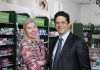




Nordic Naturals announces the opening of its new corporate headquarters in Watsonville, California, registered with the U.S. Green Building Council (USGBC) as a Leadership in Energy and Environmental Design (LEED) project. The LEED Green Building Rating System is a third-party certification program and the nationally accepted benchmark for the design, construction, and operation of high performance green buildings. The LEED program promotes a whole-building approach to sustainability by recognizing performance in five key areas of human and environmental health: sustainable site development, water savings, energy efficiency, materials selection, and indoor environmental quality.
UAS Laboratories Inc. has become the sole owner of Wisconsin’s APN Labs
APN Labs, active in the US for the past ten years, operates a facility and equipment that meet the strict FDA and state health department requirements as well as the current Good Manufacturing Practice (cGMP) guidelines. “With the acquisition of APN Labs, we are now in a great position to provide a complete range of probiotics and other speciality nutritional supplements including our branded products as well as customer private label products,” said Dr S.K. Dash, president of UAS Laboratories. “UAS Labs has extensive experience in formulation of probiotics and other speciality nutraceuticals and we will now be able to offer many more services,” added Dr Dash. APN Labs’s expertise in custom manufacturing and private labels currently allows the development of products from conception to completion for their customers, said UAS, with product options including bulk capsules, tablets and powder.
NovaVision Inc. Acquired by Neurological Medical Device Innovator Vycor Medical Inc.
There’s renewed hope for tens of millions worldwide with neurological vision loss who erroneously believe blindness due to stroke, brain cancer or brain injury to be untreatable. Medical device innovator Vycor Medical, Inc. (OTCBB: VYCO) has acquired NovaVision, Inc. (www. NovaVision.com), the only provider of progressive, scientifically based technologies that reverse and restore neurological visual loss. Together the companies will promote NovaVision’s FDA-approved, non-invasive light stimulation-based Vision Restoration Therapy (VRT) platform clinically proven to permanently restore lost vision resulting from stroke, brain cancer, traumatic or other acquired brain injury. “On average VRT patients permanently recover 5 degrees of central vision, a critical gain for conducting many daily activities,” Tom Bridges NovaVision vice president of sales and marketing notes. More than 10 years of research and data support the efficacy of NovaVision’s neurostimulation therapy approach. The medical devise is expected to be available by a prescription from any ophthamologist, neurologist or physiatrist in the U.S.
Cyanotech’s Natural Astaxanthin Obtains GRAS Status
Cyanotech Corporation (Nasdaq: CYAN) announced today that its industry-leading product, BioAstin® Natural Astaxanthin, has obtained self-affirmed GRAS status (Generally Recognized As Safe for use in food and beverage applications) by a panel of experts assembled by GRAS Associates, LLC. GRAS assessment documentation has been submitted to the US Food & Drug Administration (FDA) for the agency’s review. “Cyanotech is pleased to have BioAstin self-affirmed with GRAS status, which will allow manufacturers to use it in a variety of functional food and beverage products,” said Gerald R. Cysewski, Ph.D., Cyanotech’s Founder and Chief Scientific Officer. “BioAstin is used as a stand-alone nutritional supplement or in supplement formulas in over 50 countries worldwide.” All Cyanotech products are produced from microalgae grown at its 90-acre facility in Kona, Hawaii using patented and proprietary technology. Cyanotech distributes to nutritional supplement, nutraceutical and cosmeceutical manufacturers.
Danisco to be acquired by DuPont for $6.3 billion
Danisco and DuPont already have a history of working together, as they are partnering over the development of second generation biofuels. DuPont Chair and CEO Ellen Kullman said: “Danisco has attractive, market-driven science businesses that offer clear synergies with DuPont Nutrition & Health and Applied BioSciences. “This transaction is a perfect strategic fit with our growth opportunities and will help us solve global challenges presented by dramatic population growth in the decades to come, specifically related to food and energy.” The acquisition, which is expected to close in Q2 2011, is expected to take a toll on earnings per share; outlook for 2011 would be reduced by between $0.30 and $0.45 per share, from the previously stated $3.30 to $3.60. DuPont has said it expects Danisco to contribute to cash and earnings in 2012, the first full year of combined operations.
Council of the Ontario College of Pharmacists to Expand Scope of Practice
On Monday, December 6, 2010, the Council of the Ontario College of Pharmacists approved for circulation a draft regulation to the Pharmacy Act to enable an expanded scope of pharmacy practice. The proposed regulation outlines the duties of pharmacists, pharmacy technicians, interns and students with respect to prescribing a drug, administering a substance by injection or inhalation and performing a procedure on tissue below the dermis as permitted by the Pharmacy Act. The regulation includes requirements that must be met in order to practice the expanded scope and the circumstances in which a member may adapt or extend a prescription or administer a substance. Links to this draft regulation, together with a list of drugs proposed for initiating therapy and a list of substances proposed for administration by injection or inhalation, can be found at http://www. ocpinfo.com/client/ocp/OCPHome.nsf/ web/Notice_ESP.
Vitamin D Council files a federal Freedom of Information request to the IOM’s FNB
The Institute of Medicine’s (IOM) Food and Nutrition Board (FNB) consulted with 14 vitamin D experts (the likes of Professor Robert Heaney at Creighton and Professor Walter Willet at Harvard) and after reading these 14 different reports – the FNB decided to suppress their reports. In December 2010, the Vitamin D Council directed their attorney to file a federal Freedom of Information (FOI) request to the IOM’s FNB for the release of these 14 reports. The FNB currently recommends 400 IU/day dose for infants and 600 IU/ day in pregnant women. Professor Bruce Hollis of the Medical University of South Carolina has shown pregnant and lactating women need at least 5,000 IU/day, not 600. Dr Hollis has also demonstrated that as much as 2000IU per day in pregnancy does not raise vitamin D to healthy levels.
Natural Standard offers CE/CME Credits
Natural Standard is now offering continuing education credits for all healthcare professionals, including medical doctors, naturopathic doctors, pharmacists, nurses and doctors of osteopathy. The continuing education programs are derived from Natural Standard’s evidence-based systematic reviews on popular herbs and supplements. In each training module, the available scientific evidence of effectiveness is evaluated using the Natural Standard Evidence-based Validated Grading Rationale™. The reviews also discuss expert opinion, folkloric precedent, history, mechanism of action, interactions, side effects, dosing and toxicology information. Review questions highlight the safety and effectiveness of each therapy. For more information, please visit www. naturalstandard.com.
CNME Accrediting Status Renewal Imminent
The Council on Naturopathic Medical Education (CNME) recently completed the second-to-last step in the renewal of CNME’s recognition as an accrediting agency by the U.S. Department of Education (USDE). The CNME’s USDE staff reviewer presented the Department’s recommendation for a five-year renewal (the maximum allowed) with no adverse findings. The National Advisory Committee for Institutional Quality and Integrity members voted unanimously to recommend that the Assistant Secretary for Post Secondary Education renew CNME’s recognition for five years. CNME’s mission is quality assurance: serving the public by accrediting naturopathic medical education programs that meet or exceed CNME’s standards. Students and graduates of programs accredited or preaccredited (candidacy) by CNME are eligible to apply for the naturopathic licensing examinations administered by the North American Board of Naturopathic Examiners (NABNE), and are generally eligible for state and provincial licensure in the U.S. and Canada. For more information, please visit: http://www.cnme. org.
Atrium Innovations Acquires Seroyal
In a statement released by Atrium Innovations Inc (TSX: ATB), Atrium announced the purchase of Seroyal International, which commercializes premium dietary supplement brands targeting healthcare practitioner channels in Canada and in the U.S. with annualized consolidated revenues of approximately $40 million USD. The transaction closed on December 31, 2010. Atrium is a globally recognized leader in the innovation, formulation, production and commercialization of science-based and professionally endorsed dietary supplements for the health & nutrition industry. Atrium markets a broad portfolio of finished products through its highly specialized sales and marketing network in more than 35 countries, primarily in North America and Europe. Seroyal was founded in 1984 and distributes three branded families of products (i.e. Genestra, Pharmax and CoreLab), and has distributed the Unda European homeopathic brand since 1990.