



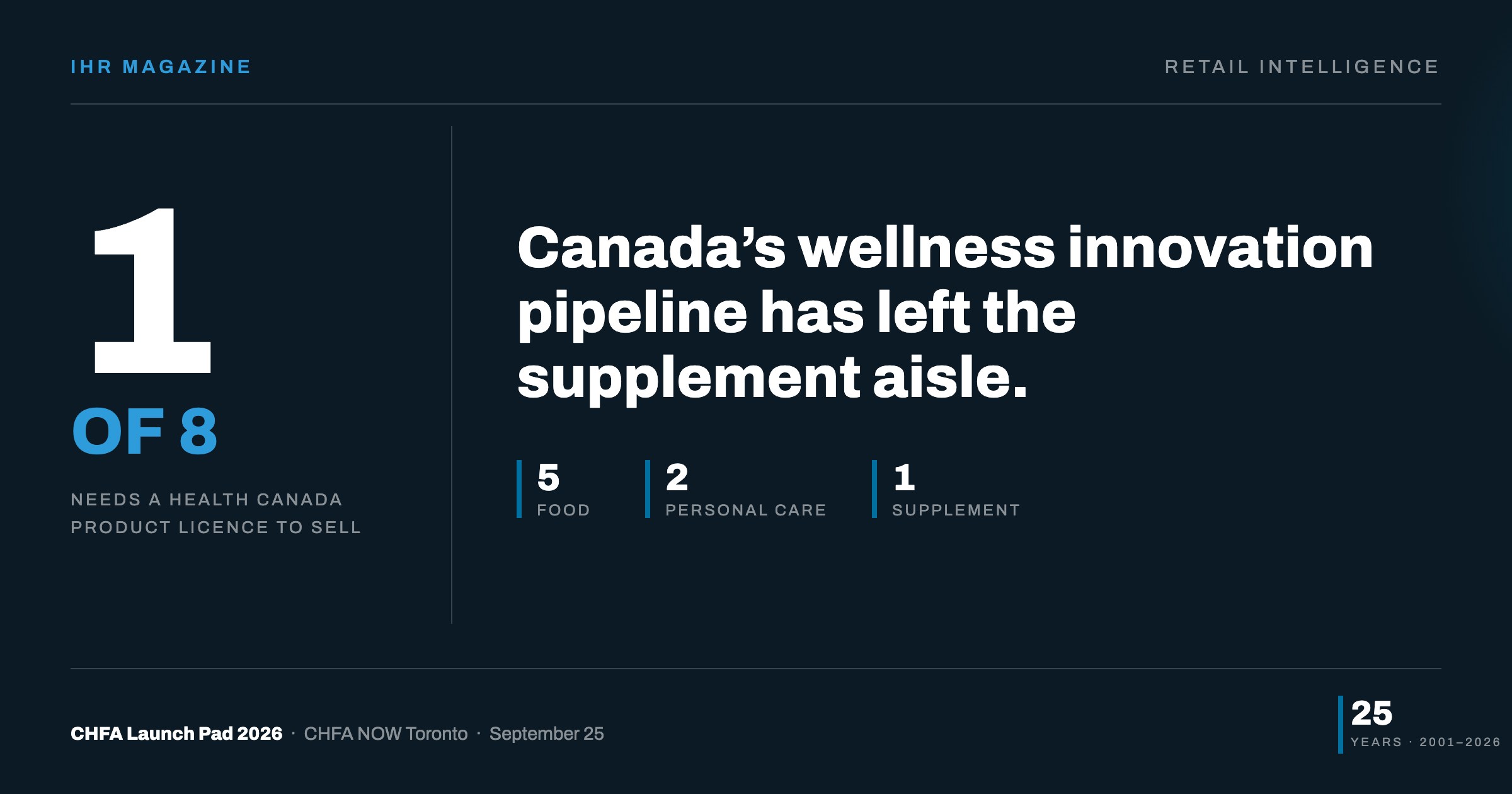
Eight emerging brands pitch for Most Innovative Product at CHFA NOW Toronto on September 25. Only one of them needs a licence from Health Canada to sell. CHFA has named its eight finalists for the 2026 Launch Pad competition, and the list rewards a second look. Five sell food. Two sell personal care. Her Dailys, a peri-menopause and menopause formula built by naturopathic doctors, stands alone as the only entrant needing a product number from Health Canada’s Natural and Non-prescription Health Products Directorate. Vancouver’s slate ran the same way earlier this year: six food and beverage brands, one skincare line, one supplement. Two competitions, sixteen finalists, two NPNs between them. Canada’s most visible showcase of emerging wellness brands has quietly become a food show.
What the eight are selling
The Toronto entries fall into three groups, and the largest is edible. Snackish arrives with a potato chip carrying 13 grams of protein and gut-friendly fibre. Suna Wellness blends ceremonial-grade Japanese matcha with 20 grams of protein, ten of them marine collagen. Pod Squad Snacks builds a waffle crisp from organic beans, whole-grain oats and milled flax; Stealthy Foods freezes vegetables and protein into single-serve sauce pucks; Tocha offers a spiced sauce that trades heat for flavour and lands in centre store. A second group never touches the mouth. Abieze makes a camelina-oil black soap that dissolves household grime instead of perfuming over it, and MOOZ ferments live probiotics into a deodorant, neither facing pre-market review of any kind. Her Dailys forms the third group alone: red clover, vitex, bacopa, CoQ10, probiotics and a vitamin-mineral base, with every functional claim on the label subject to review before a case can ship.
Protein escapes its aisle
Two of those entries lead with a gram count, which tells you where demand has travelled. CHFA president and chief executive Aaron Skelton describes consumers who want to age well rather than simply live long, and brands across the $28-billion Canadian natural, organic and wellness sector are answering with protein density, muscle maintenance and gut health as GLP-1 prescriptions reshape appetite. For a retailer that is a planogram problem. Protein has stopped behaving like a category and started behaving like an attribute, turning up in chips, in matcha and soon in condiments, so the shopper hunting grams no longer walks to the sports nutrition set. Independents who still concentrate protein in one bay are handing the incremental basket to grocery chains that scattered it across the store years ago. Stealthy Foods sharpens the point. Frozen single-serve formats need freezer doors, and most independent health food stores either lack them or filled them long ago. A frozen brand reaching a national pitch stage suggests the next wave of functional food will arrive cold, and a store without capacity gets excluded by its own architecture, whatever its buyer decides.
The arithmetic behind the format shift
None of this reflects fashion. A natural health product requires a licensed site, an approved product licence and a claims file that survives Health Canada review before a single case ships; a high-protein chip requires a compliant nutrition panel. Founders weighing those routes are weighing eighteen months against a season, and the gap should widen. Health Canada proposed cost-recovery fees for natural health products in May 2023 and revised them in March 2024 without bringing them into force, and final figures still await publication in the Canada Gazette, Part II while the department works through its red-tape agenda. Nobody is waiting for the final number before pricing in the direction of travel on regulatory cost. That does not make the food route a free pass. A collagen beverage can fall under either framework depending on what the label claims, and a supplier who chose food forfeits therapeutic language permanently. Compliance exposure does not evaporate; it moves onto the shelf talker, the endcap sign and whatever a staff member says at the counter, all of which belong to the retailer. Which is the case for the outlier. Her Dailys can state what its formula supports because it paid for the right, Snackish cannot and has no need to, and for a category manager building a women’s health set that difference decides which product carries the in-store education.
What the shortlist is worth on the floor
One filter shapes every Launch Pad slate: competitors must exhibit at CHFA NOW, so the finalists represent emerging brands with the capital to buy a booth, and many of the regional suppliers that genuinely differentiate an independent store never reach the floor. What the competition does deliver is a shortlist with judgement attached. Isabele Chevalier of NAD Capital, Shelley R. King of Natural Products Canada and Steve Hollingsworth of Nature’s Emporium give each founder two minutes to pitch against four minutes of questioning, and the questions repay attention more than the verdict, particularly from the retailer on the panel, who is pressure-testing the listing decision every buyer in the room faces. The prize rewards a commercial eye too. Toronto’s package clears $25,000 across brand consultation from Brand Natural, a retail media package from In Conversation with Bruce W. Cole, CHFA promotion, a booth at the next show and a year of membership; Vancouver’s, on a different sponsor group, passed $50,000 and carried a NielsenIQ data and consulting component. Scan data often outvalues everything else in a package like that, because it converts a founder’s conviction into velocity evidence a category manager can act on. That is the frame for the session itself: the finalists are screened, already on the floor and reachable for two days afterwards, and three small trials in the thinnest parts of an assortment will justify the hour. For most independents heading into 2027 planning, those gaps sit in functional snacking and women’s health.
Frequently Asked Questions
When and where is the 2026 CHFA Launch Pad competition?
The competition runs Friday, September 25 at 5:00 p.m. in room 206BCD of the Automotive Building at Exhibition Place, Toronto, during CHFA NOW Toronto. Attendance is open to all attendee and exhibitor badge types, and no conference pass is required.
Who are the eight finalists?
Abieze with a camelina black soap, Her Dailys with a peri and menopause multi, MOOZ with a probiotic deodorant, Pod Squad Snacks with mini waffle crisps, Snackish with high-protein chips, Stealthy Foods with frozen sauce pucks, Suna Wellness with a protein ceremonial matcha, and Tocha with spiced sauces.
What does the winner receive?
The Most Innovative Product winner takes a package worth more than $25,000: $10,000 in brand consultation from Brand Natural, a $10,000 retail media and visibility package from In Conversation with Bruce W. Cole, promotion across CHFA channels, media exposure, a booth at the next CHFA NOW show and a complimentary one-year CHFA membership.
How do brands qualify for CHFA Launch Pad?
Entrants must be emerging natural, organic or wellness brands whose product has recently launched or is preparing to launch in Canada, and they must exhibit at CHFA NOW to compete. Applications for the Toronto competition closed on June 20, 2026.
Why do so few finalists sell licensed supplements?
Food and personal care formats reach shelf faster and skip pre-market product licensing, while a natural health product needs a site licence, a product licence and a claims review first. Across both 2026 Launch Pad slates, only two of sixteen finalists carried a natural health product number. This is independent editorial analysis by IHR Magazine. It references CHFA Launch Pad finalists as examples of category movement and does not endorse any brand or product. Retailers should verify NPN status, site licensing and authorized claims before listing.
Cet article est aussi disponible en français : CHFA Launch Pad 2026 : deux finalistes québécois, et ni l’un ni l’autre n’a besoin d’une licence de Santé Canada.