



Ahead of its September 2026 launch, the decentralized health commerce platform, now in beta, previews a feature that lets every store, independent or chain, choose exactly who fulfils its online orders, from its own distributors to a corporate logistics centre, without giving up the network’s safety net.
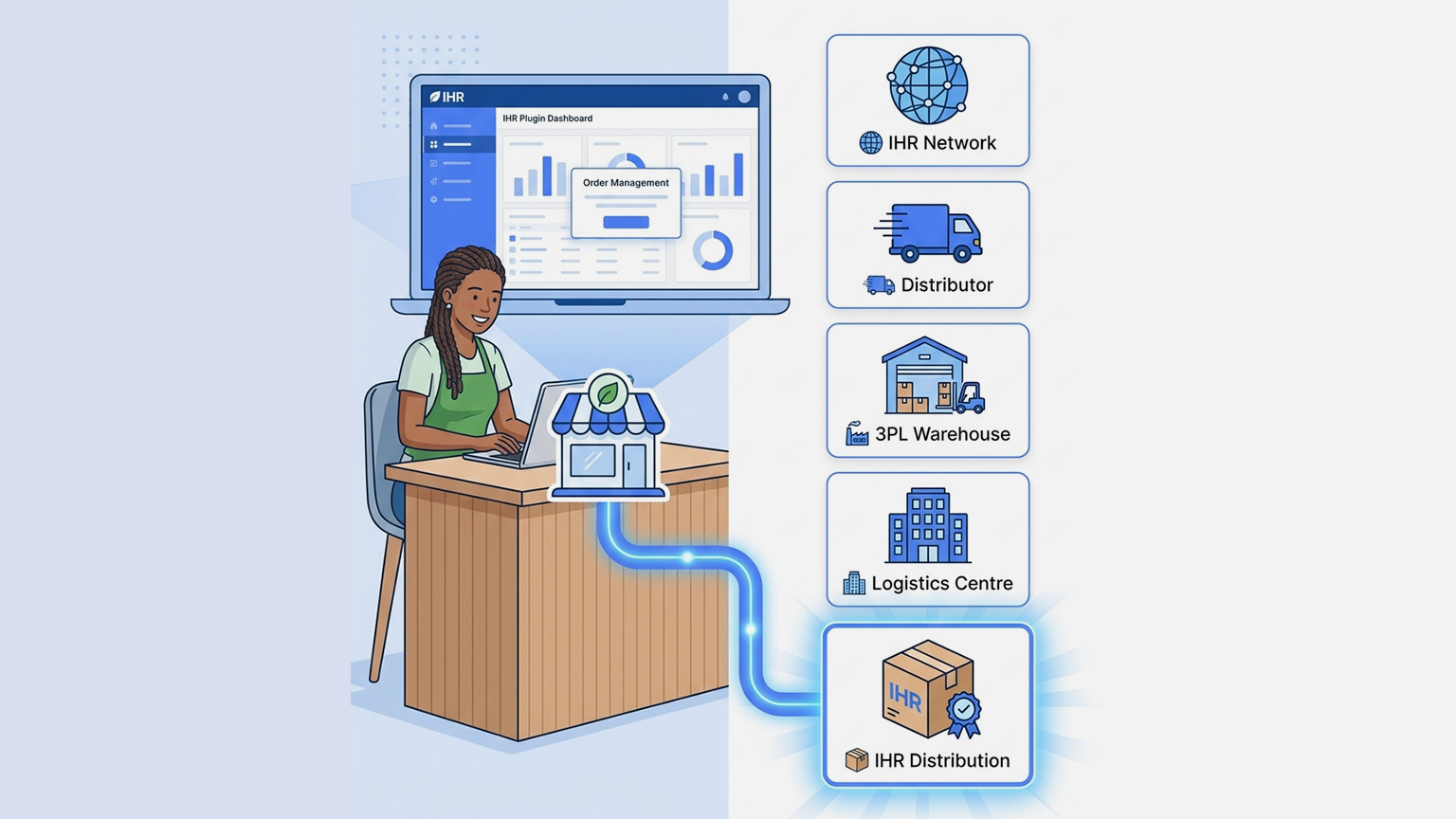
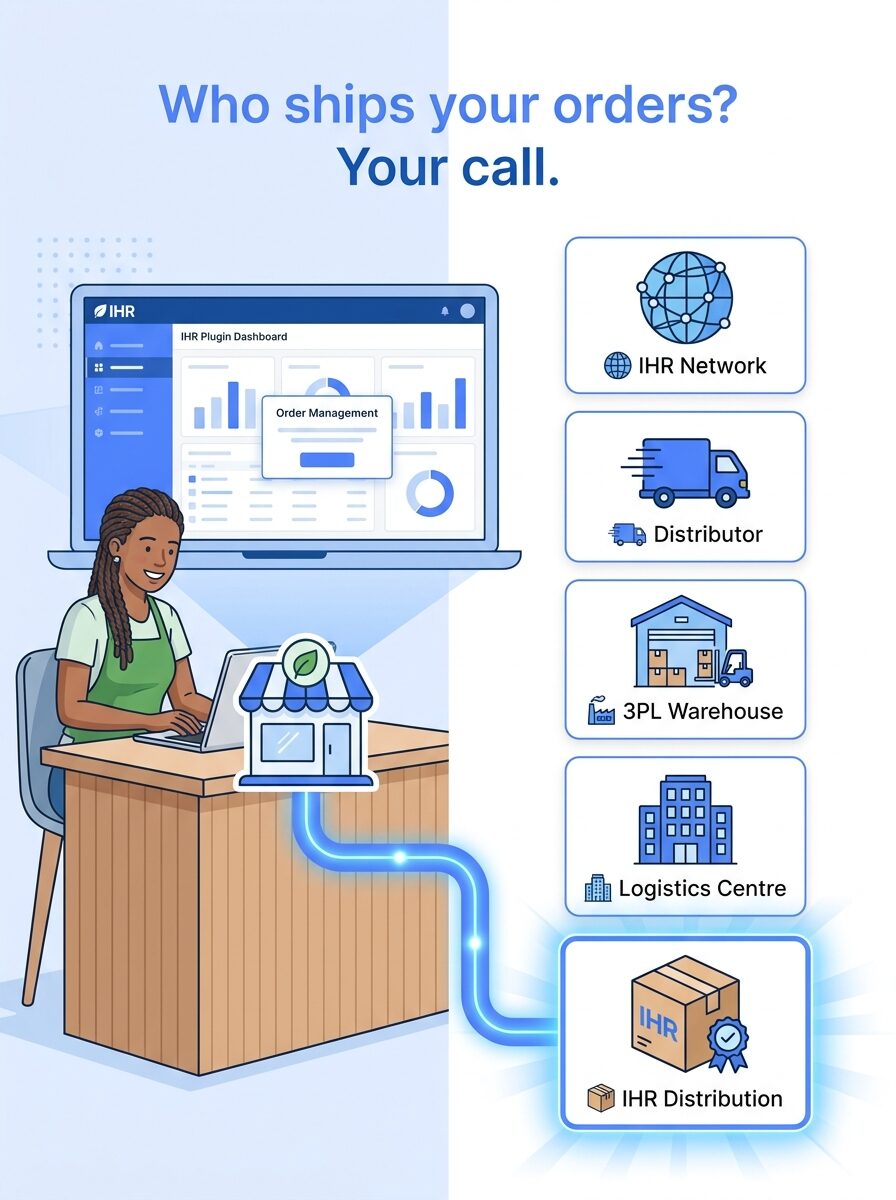
What is the fulfilment-strategy selector? It is a new IHR Plugin setting that lets each health food store choose who fulfils its online orders: the IHR network, up to five of its own distributors, a 3PL warehouse, a corporate logistics centre, or an IHR distribution centre—and enforces that choice across manual, Shopify, and WooCommerce order routing.
Key takeaways
-
Retailers pick one of five fulfilment strategies; the IHR network remains the zero-setup default.
-
Every entered location becomes a routing node, and all order channels honour the choice — orders ship only from the chosen fulfiller(s).
-
Out-of-stock orders backorder and alert the store by default; an optional per-store toggle allows IHR network fallback.
-
The IHR Plugin is free, currently in beta, and launches in September 2026.
The IHR Plugin’s core promise to natural health food retailers is simple: connect your store to a decentralized network of inventory, and stop worrying about who ships what. Every participating retailer becomes a micro-warehouse, orders route to the closest available stock, and stores can offer an “infinite shelf” without carrying the inventory themselves.
That model works for many shops. But as the platform’s beta program has drawn in multi-store groups, banner chains, and retailers with long-standing distributor relationships, one piece of feedback keeps coming back: not every store wants the network to decide where its orders ship from. Some have negotiated distributor terms they need to honour. Some chains route everything through their own logistics centre. Some retailers simply want their trusted 3PL to keep doing the job.
The fulfilment-strategy selector — one of the features the IHR Plugin is previewing ahead of launch, answers that directly. It turns what would otherwise be a fixed, network-first routing model into a choice the retailer makes and the platform enforces.
Five Ways to Fulfil
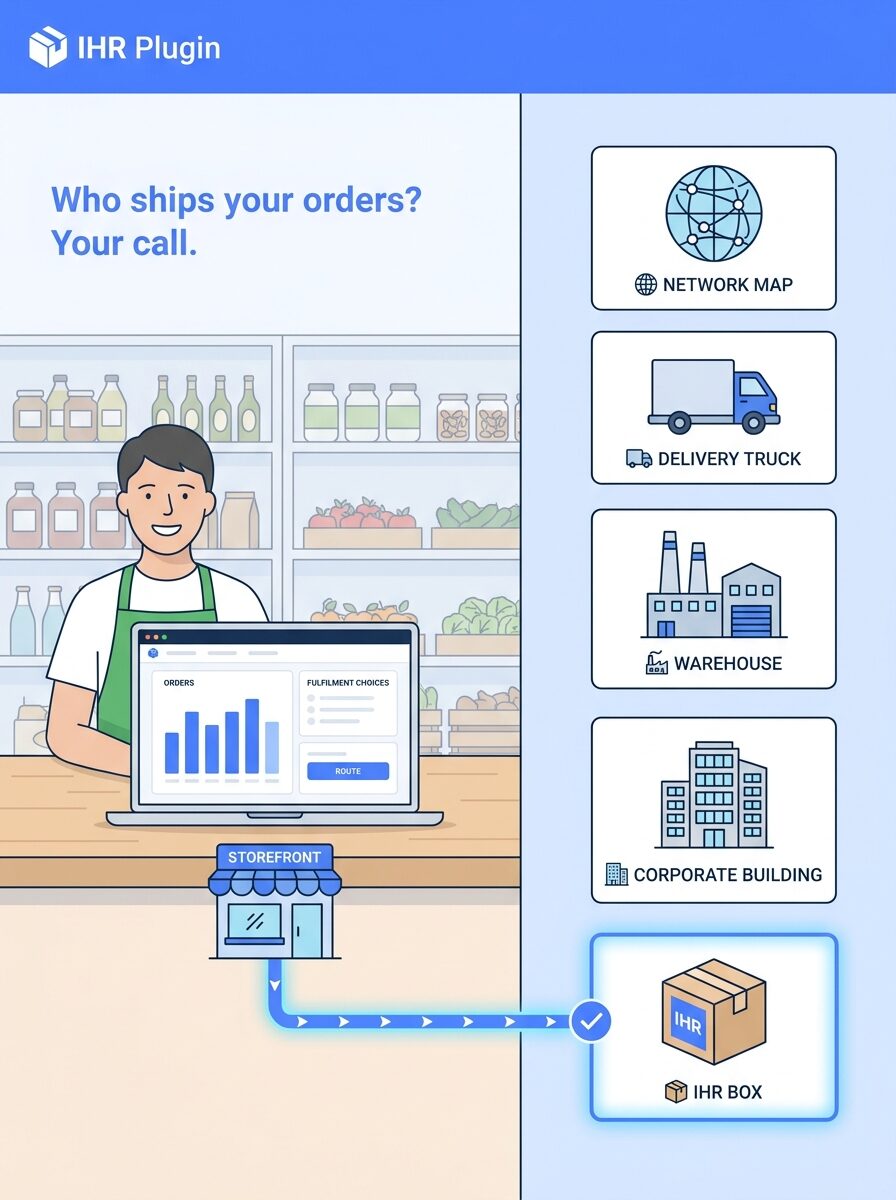
The selector presents each store with five clickable fulfilment strategies:
• IHR Plugin network. The default, and the zero-setup option. Orders route through the decentralized network of participating retailers, vendors, and distribution points. Stores that are happy with network fulfilment don’t need to touch anything.
• My distributor(s). For stores with established wholesale relationships, this option lets them register one to five of their own distributors, entering each location individually. Orders then flow to those distributors and nowhere else.
• 3PL warehouse. Retailers who have outsourced logistics to a third-party fulfilment provider can point the platform at that warehouse and keep their existing operation intact.
• Corporate logistics centre. Built for groups and chains. A banner with fifteen storefronts can designate a single corporate centre, and every store in the group ships from it , one node, one inventory pool, one set of shipping rules.
• IHR distribution centre. Stores that want dedicated fulfilment without running their own logistics can route orders through an IHR distribution centre.
Each location a retailer enters becomes a routing node in the platform. That matters more than it sounds: the selector isn’t a preference that gets consulted sometimes. Every order-routing path the platform supports, manual orders, Shopify storefronts, WooCommerce stores, now honours the store’s choice. If a retailer picks its two distributors, orders go to those two distributors, period. The network doesn’t quietly step in.
The Out-of-Stock Question
Any retailer who has run a dropship or distributor program knows where this design gets tested: what happens when the chosen fulfiller doesn’t have the product?
The IHR Plugin’s answer is deliberately conservative. By default, the order backorders and the store is alerted. Nothing ships from an unexpected source, no surprise invoice arrives from a fulfiller the retailer never chose, and the store decides how to resolve it wait for restock, contact the distributor, or cancel and refund.
For stores that would rather never make a customer wait, there’s a per-store toggle: allow IHR network fallback. Flip it on, and an out-of-stock order at the chosen fulfiller automatically falls back to the IHR Plugin network, shipping from the nearest participating node instead. It’s the best of both worlds for retailers who want distributor-first routing with the network as insurance, and it stays off unless the store turns it on.
That default-off choice is worth noting. Plenty of platforms would have made fallback automatic and called it a feature. Making it opt-in signals that the IHR Plugin treats fulfilment relationships as commercial commitments, not just logistics plumbing.
Why This Matters for the Trade
Distributor relationships survive the move online. The biggest quiet objection to network-based fulfilment has always been channel conflict. A store that has spent a decade building terms, rebates, and credit with its regional distributor doesn’t want an e-commerce plugin rerouting that volume elsewhere. The selector lets that store digitize without disintermediating anyone.
Chains get the control they’re used to. Multi-store groups typically centralize purchasing and logistics for good reasons: volume pricing, consistent stock, one receiving operation. The corporate logistics centre option maps the platform onto that reality instead of asking the chain to restructure around the network.
Independents keep the zero-effort path. Nothing changes for the single store that joined precisely because it didn’t want to think about fulfilment. The network remains the default, with no setup required.
Suppliers keep their guardrails. The platform’s brand controls , minimum advertised pricing and supplier control over which retailers carry their goods, apply regardless of which fulfilment strategy a store selects.
The Bigger Picture
The natural health retail channel has spent the past several years squeezed between consumer delivery expectations set by the major e-commerce platforms and the economics of small-format retail. The IHR Plugin’s pitch , decentralized inventory, shared fulfilment, and AI-driven marketing, with a free subscription, is about giving independents the infrastructure to compete.
The fulfilment-strategy selector shows a platform maturing before it even launches. A platform confident enough to let retailers route orders away from its own network is making a bet: that flexibility, not lock-in, is what keeps stores on the platform. For a channel built on independent operators, family-owned chains, and long-memory distributor relationships, that bet reads the room correctly.
In a category where trust is the product, that kind of control is not a small feature. It’s the difference between a platform stores use and a platform stores build on.
Frequently Asked Questions
When does the IHR Plugin launch?
The IHR Plugin is currently in beta and launches in September 2026. Features such as the fulfilment-strategy selector are being previewed ahead of launch.
How much does the IHR Plugin cost?
The subscription is free. Stores connect their storefront and choose a fulfilment strategy without a monthly fee.
Which fulfilment options can a store choose?
Five: the IHR Plugin network (default, zero setup), the store’s own distributors (one to five locations), a 3PL warehouse, a corporate logistics centre for groups and chains, or an IHR distribution centre.
What happens if the chosen fulfiller is out of stock?
By default the order backorders and the store is alerted nothing ships from an unapproved source. Each store can optionally enable an “allow IHR network fallback” toggle so out-of-stock orders ship from the nearest network node instead.
Does the selector work with Shopify and WooCommerce?
Yes. All order routing manual orders, Shopify, and WooCommerce honours the store’s chosen fulfilment strategy.
The IHR Plugin (ihrplugin.com) is a decentralized health commerce platform for natural health retailers, supporting order fulfilment, inventory, earnings, and network management across manual, Shopify, and WooCommerce order channels. Currently in beta, it launches in September 2026.