






Skin health is no longer being viewed only through a cosmetic lens. Increasingly, consumers are connecting the appearance of their skin with broader physiological balance, inflammation status, circulation, hydration and healthy ageing. For health retailers, that shift matters.
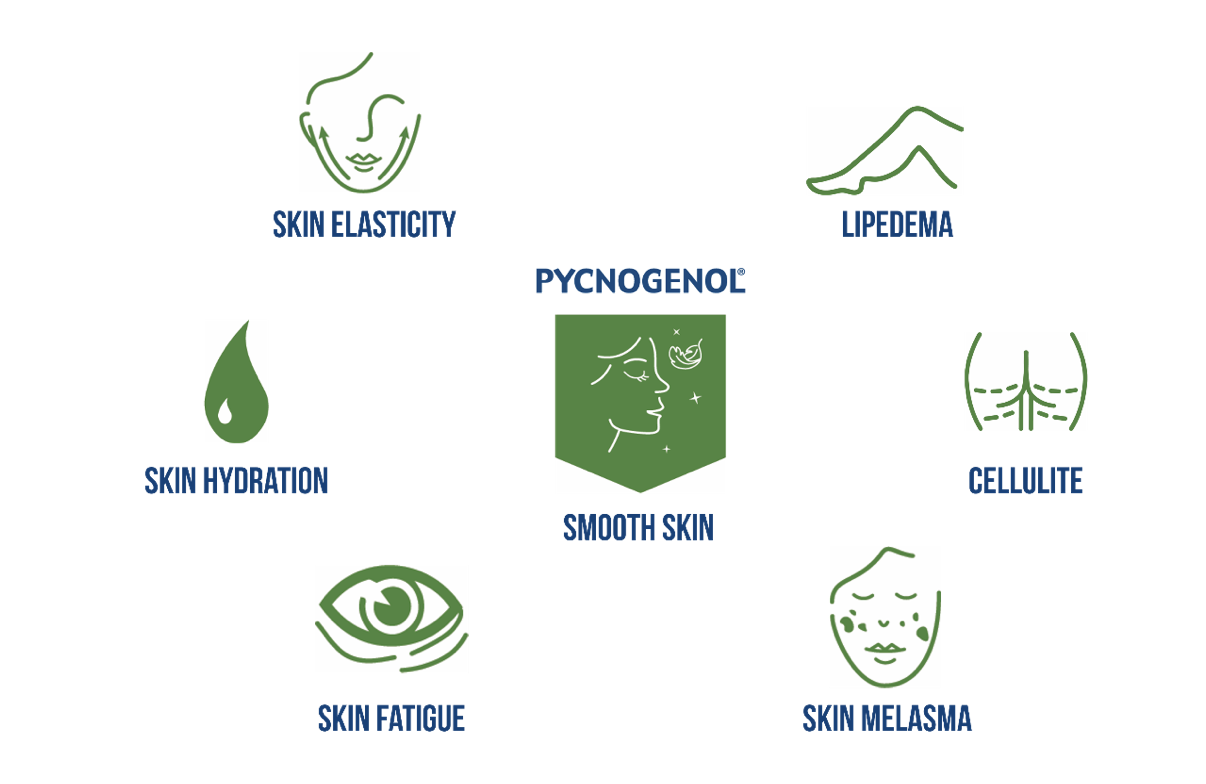
The beauty-from-within category continues to expand as shoppers look for evidence-based ingredients that support not only how skin looks, but also how it functions. One ingredient drawing renewed attention is Pycnogenol, a branded French maritime pine bark extract that has been studied for its effects on skin hydration, elasticity, barrier integrity, microcirculation and visible signs of skin fatigue.
For retailers educating customers in the natural health space, the opportunity is not simply to position Pycnogenol as a “beauty” ingredient. The stronger story is that it may help support the structural and physiological foundations of healthy-looking skin.
Why skin support from within matters
Healthy skin depends on several key internal factors: moisture retention, connective tissue integrity, barrier resilience and adequate circulation. When those systems are functioning well, skin is better able to cope with environmental stressors such as UV exposure, pollution, seasonal dryness, weight fluctuation and age-related changes.
This is where oral supplementation can become relevant. Rather than working only at the surface, ingestible ingredients may help support the skin’s underlying structure and biological processes.
Research on Pycnogenol suggests it may offer benefits across several of these mechanisms, particularly when used consistently over a period of weeks or months.
What the research says about hydration and elasticity
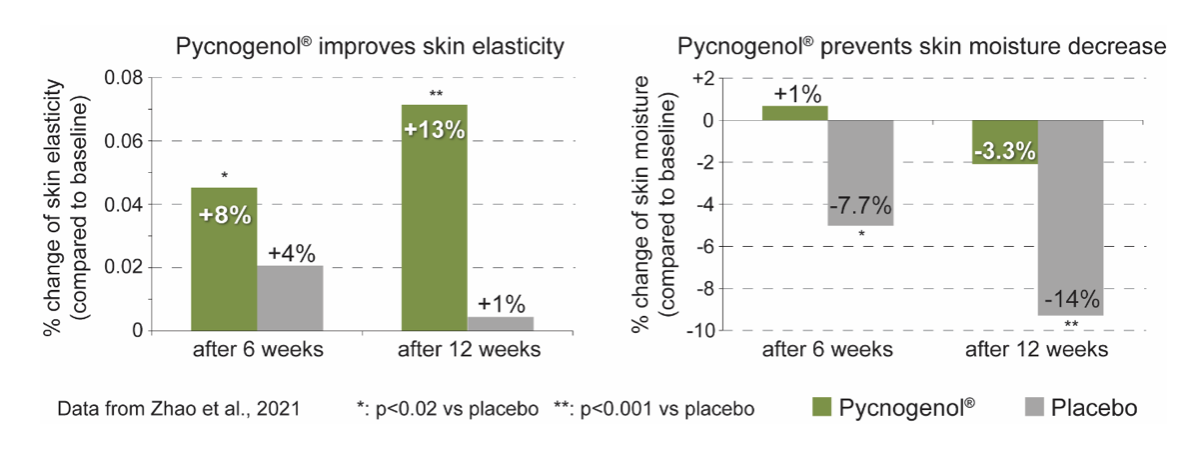
Some of the most compelling data around Pycnogenol relates to skin moisture and elasticity.
Clinical studies cited in the research package show that supplementation may help increase the expression of hyaluronic acid synthase, a key enzyme involved in producing hyaluronic acid in the skin. That matters because hyaluronic acid plays a central role in tissue hydration, smoothness and structural integrity. In the same body of research, Pycnogenol was also associated with increased collagen synthesis, another major factor in skin firmness and resilience.
For retailers, this creates a clear educational message: Pycnogenol may support skin by helping the body maintain the building blocks that contribute to smoother, more hydrated and more elastic skin.
Additional studies also suggest that Pycnogenol may help reduce the activity of enzymes that break down collagen and elastin. In practical terms, that means the ingredient may not only support production of important skin compounds, but also help protect them from degradation.
That dual mechanism is particularly relevant for shoppers focused on visible ageing, dryness, loss of firmness and skin fatigue.
A noteworthy angle: skin barrier support
One of the strongest retailer talking points in the current skin-health conversation is barrier function.
Consumers are increasingly familiar with the skin barrier because of mainstream skincare messaging, but many do not realize that internal support may also play a role. Research referenced in the supplied material suggests Pycnogenol may help reduce transepidermal water loss and support genes involved in barrier formation, including markers linked to keratinocyte differentiation.
This is important because strong barrier function helps the skin retain moisture and better defend itself against everyday stress. For health retailers, that means Pycnogenol may fit naturally into discussions around dry skin, seasonal skin stress, mature skin and overall skin resilience.
Microcirculation: an overlooked part of skin health
Good skin is not just about collagen and hydration. Blood flow matters too.
The supplied research highlights Pycnogenol’s role in supporting microcirculation and blood flow, which are essential for delivering oxygen and nutrients throughout the body, including to the skin. This is a valuable angle for retailers because it broadens the conversation beyond appearance.
When consumers ask why internal skin support works differently from topical care, circulation is part of the answer. Nutrients need to reach tissues efficiently, and healthy microcirculation supports that process.
This may be one reason Pycnogenol is increasingly being viewed as a more holistic beauty-from-within ingredient rather than a simple vanity product.
Photo-ageing and uneven pigmentation
The research package also points to a growing body of evidence around photo-ageing and melasma-related pigmentation.
Studies cited in the material suggest Pycnogenol may help reduce the area and intensity of melasma and may contribute to a more even-looking complexion. Mechanistically, this appears to be linked in part to the suppression of tyrosinase activity, an enzyme involved in melanin production, along with photoprotective effects related to UV response.
For retailers, this is an area that requires careful language. The most responsible framing is not to position Pycnogenol as a treatment, but rather as an ingredient that may help support a healthier-looking, more even complexion and help defend the skin from some visible effects of photo-ageing.
That distinction is important for both consumer trust and regulatory prudence.
Newer interest: cellulite appearance and leg comfort
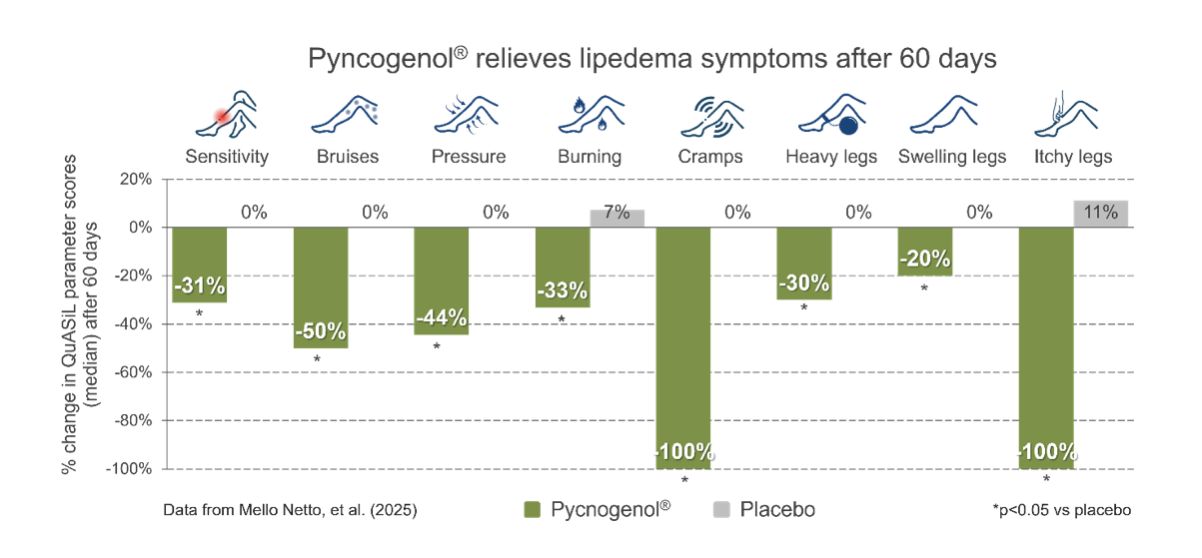
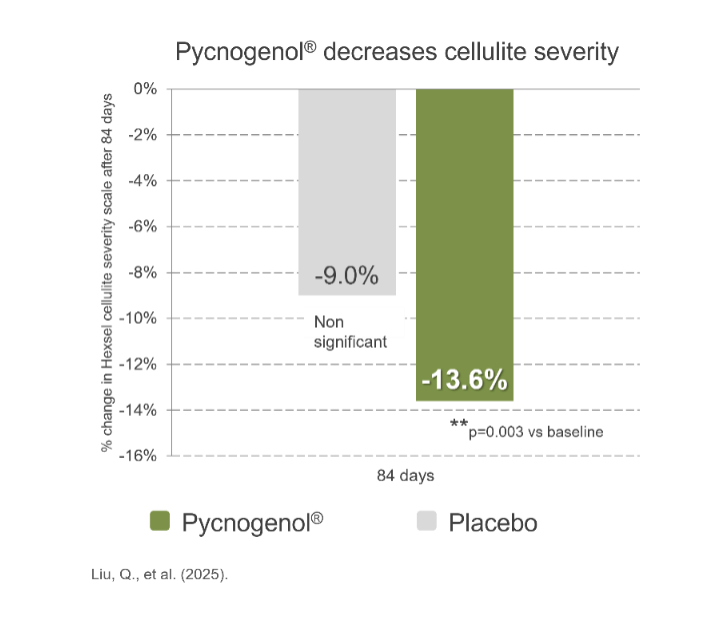
Beyond facial skin, newer studies cited in the material explore Pycnogenol’s potential role in cellulite severity, skin smoothness and symptoms associated with lipedema, including swelling, heaviness and bruising in the legs.
This is an emerging but commercially interesting area, especially as consumers seek non-invasive, lifestyle-friendly support for leg comfort and skin appearance. The ingredient’s antioxidant, anti-inflammatory and circulation-support benefits may be relevant here.
Again, retailers should keep the messaging grounded. The most appropriate education angle is that recent research suggests Pycnogenol may support leg appearance, microcirculation and comfort in certain populations, while avoiding overstatement.
What health retailers should take from this
For the natural health channel, Pycnogenol sits at the intersection of several active consumer trends:
- beauty from within
- healthy ageing
- skin barrier support
- antioxidant support
- circulation and microcirculation
- women’s wellness
That makes it a versatile ingredient story for retailers building out a modern skin-health assortment.
It may be especially relevant for shoppers looking for:
- support for dry or tired-looking skin
- help maintaining skin elasticity as they age
- inside-out support to pair with topical routines
- ingredients connected to circulation and visible skin quality
- evidence-based beauty supplements rather than trend-driven formulas
FAQ
What is Pycnogenol?
Pycnogenol is a branded extract from French maritime pine bark that has been studied for antioxidant, circulation and skin-related benefits.
How does Pycnogenol support skin health?
Research suggests it may support collagen production, hyaluronic acid synthesis, barrier function, skin hydration, elasticity and microcirculation.
Is the evidence only cosmetic?
No. The broader value proposition is physiological support for the skin’s structure and function, not just appearance.
What consumer need does it fit?
It aligns well with beauty-from-within, healthy ageing, dry skin support, skin resilience and women’s wellness positioning.
What should retailers be careful about?
Avoid overstating disease or treatment claims. Education should stay evidence-based, measured and compliant with applicable Canadian regulations and approved product language.
Sources / References
- Zhao H, et al. Skin Pharmacology and Physiology. 2021;34(3):135-145.
- Marini A, et al. Skin Pharmacology and Physiology. 2012;25(2):86-92.
- Grimm T, et al. Free Radical Biology and Medicine. 2004;36(6):811-822.
- Grimm T, et al. Journal of Inflammation. 2006;3:1.
- Grether-Beck S, et al. Skin Pharmacology and Physiology. 2016;29(1):13-17.
- Wang S, et al. European Bulletin of Drug Research. 1999;7(2):19-25.
- Belcaro G, et al. Clinical and Applied Thrombosis/Hemostasis. 2006;12(3):318-323.
- de Souza Lima Hara WY. State University of Rio de Janeiro; 2023.
- Enseleit F, et al. European Heart Journal. 2012;33(13):1589-1597.
- Nishioka K, et al. Hypertension Research. 2007;30(9):775-780.
- Zibadi S, et al. Nutrition Research. 2008;28(5):315-320.
- Liu Q, et al. Phytomedicine Plus. 2025;5(3):100821.
- Seabra De Mello Netto BA, et al. Jornal Vascular Brasileiro. 2025.
- Kim YJ, et al. Food and Chemical Toxicology. 2008;46(7):2466-2471.
- Leis Ayres E, et al. Journal of Cosmetic Dermatology. 2022;21(3):1234-1242.
- Pinto CAS, et al. Surgical & Cosmetic Dermatology. 2015;7(3):218-222.
- Ni Z, et al. Phytotherapy Research. 2002;16(6):567-571.
- Saliou C, et al. Free Radical Biology and Medicine. 2001;30(2):154-160.
- Karamanos NK, et al. The FEBS Journal. 2021;288(24):6850-6912.
- Kwon SH, et al. Experimental Dermatology. 2019;28(6):704-708.
- Kruppa P, et al. Deutsches Ärzteblatt International. 2020;117(22-23):396-403.
- Ryan J, et al. Journal of Psychopharmacology. 2008;22(5):553-562.
- Chovanova Z, et al. Free Radical Research. 2006;40(9):1003-1010.
- Ďuračková Z, et al. Nutrition Research. 2003;23(9):1189-1198.
- Devaraj S, et al. Lipids. 2002;37(10):931-934.
- Kolacek M, et al. Free Radical Research. 2013;47(8):624-634.
- Yang HM, et al. Acta Obstetricia et Gynecologica Scandinavica. 2007;86(8):978-985.
- Canali R, et al. International Immunopharmacology. 2009;9(10):1145-1149.
- Schäfer A, et al. Biomedicine & Pharmacotherapy. 2005;60(1):5-9.
- Gabriel A, et al. Aesthetic Surgery Journal Open Forum. 2023;5:1-13.