




Peptide demand has reached the counter. Know which products expose a store and its officers to federal charges, which peptide claims are licensed, and why “the FDA allows it” means nothing here.
By Olivier Fel., IHR Magazine. November 4, 2026.
One vial of BPC-157 can make a health store a federal defendant. Under the Food and Drugs Act, every day of sale is a separate offence. A director who tolerates the sale can be charged even if the company is not. Enforcement against unauthorized peptides in Canada has also reached licensed retail. A Coquitlam, B.C. supplier sold ten lots of BPC-157 and GHK-Cu powder to compounding and community pharmacies before a Type I recall on May 5, 2026.
Shoppers who have watched peptide videos now ask for these products by name. Many have been told that a new U.S. policy makes them legal. In Canada, it does not. This article sets out what no store can sell, what Health Canada does license, and why illegal products are still advertised to Canadians.
On October 23, 2026, the department published a page dedicated to peptides. It lists 13 products found online and on social media, from BPC-157 and TB-500 to Retatrutide and Melanotan I and II. Every synthetic peptide on that list is a drug in Canada. The legal opportunity lies with food-derived peptides, such as collagen, that already carry licensed claims.
What is an unauthorized peptide in Canada? It is any peptide sold for human use without a Drug Identification Number (DIN) or Natural Product Number (NPN). Injectable peptides are always regulated as drugs, so a natural health product licence can never cover them.
Demand is loud, and Canadian data is missing
U.S. peptide-related Google searches hit 10.1 million in January 2026, according to an analysis by The Peptide Effect reported by CBS News. About 60 per cent were for GLP-1 drugs, and searches for “longevity” peptides rose nearly 300 per cent in a year. The peptides hashtag appears on more than 270,000 TikTok videos and 654,000 Instagram posts.
Sellers have moved to meet that interest. A Financial Times report, cited by eMarketer, counted roughly 1,000 Chinese vendors shipping unregulated peptides directly to Western consumers, with vials priced as low as US$5. No public source measures the Canadian peptide market or Canadian search volume. The U.S. figures are the best available guide to the questions now reaching Canadian stores.
Unauthorized peptides in Canada: what no store can stock
Anything injectable stays off the shelf. Authorized products carry an eight-digit DIN or NPN, and grey-market vials carry neither. Health Canada’s April 9, 2026 advisory named 14 products, adding NAD+ to the injectables it had already seized.
Enforcement has grown steadily. Inspectors seized 26 injectable products from a Calgary wellness centre in April 2025. An online seller called Canada Peptide had about 50 listed products flagged that August. In December 2025, a Vancouver gym surrendered 25 products, 22 of them peptides, including pre-mixed “Glow” and “Klow” blends.
Sports nutrition retailers face another set of rules. WADA’s 2026 Prohibited List bans BPC-157 under category S0 and names CJC-1295, ipamorelin and TB-500 under S2. A Canadian volleyball player received a four-year ban after testing positive for BPC-157 and TB-500, according to BSCG.
The penalties reach individuals
Under section 31.2 of the Act, a therapeutic-product offence carries a fine of up to $5 million and two years in prison on indictment. A first summary conviction carries up to $250,000 and six months, and a repeat conviction up to $500,000 and 18 months.
Section 31.7 counts each day of sale as its own offence. Under section 31.6, any director or officer who authorizes or accepts the offence is a party to it. Section 31.4 raises the maximum to five years in prison when someone knowingly or recklessly causes a serious risk of injury.
Health Canada’s lab tests show why the department is pressing. Some seized vials held no peptide at all, some labels listed peptides that were missing, and one injectable was not sterile.
A “research use only” label is not a licence
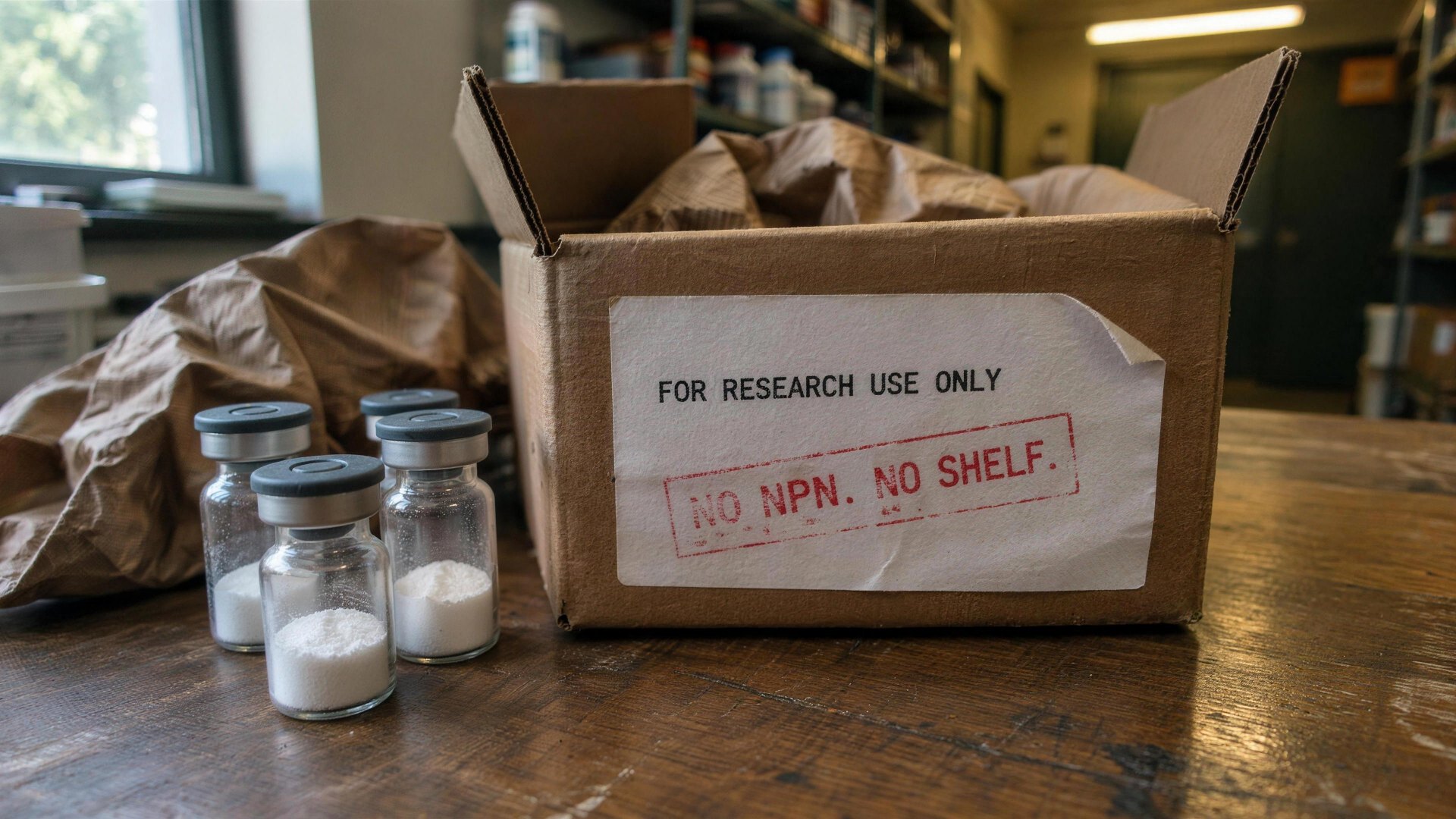
Peptides can legally be sold to universities, laboratories and biotech companies for research that never involves people. Testing in humans requires separate clinical trial approval. A vial sold to the public for recovery, sleep or fat loss fits neither category.
Health Canada states that a research label does not make a product legal to import or sell. According to law firm Fasken, regulators look at the whole business: website content, customers, order patterns and the supplies sold with the vial. If those point to human use, the product is treated as an unauthorized drug, and shipments meant for resale can be held at the border.
The label can even hurt the seller, because it suggests the seller knew the product was not approved for people. For a store, the rule is simple. Without a DIN or NPN, a product does not go on the shelf, whatever the box says.
Ordering from overseas does not make it legal
Many shoppers skip the store and order vials from abroad, shipped to their door under a research label. Health Canada’s personal-import guidance (GUI-0116) does not cover them. Canadian residents generally may not import prescription drugs by mail or courier, and injectable peptides are prescription drugs.
Even products that individuals may import are capped at a 90-day supply or one course of treatment, whichever is less. Repeat orders above that limit can turn a buyer into a commercial importer. The only legal route to an unapproved drug is through a Canadian physician and the Special Access Program, which is reserved for serious or life-threatening conditions.
Public enforcement so far has targeted sellers, not individual buyers, whose usual loss is a seized parcel. That changes quickly for anyone who buys in volume to share or resell, at a gym for example. For stores, the direct channel takes the customer but leaves the risk with them. A licensed product on the shelf is the safer alternative staff can offer.
How Canada and the U.S. differ
The two countries now differ on who may sell, compound and advertise these products.
| Question | Canada | United States |
|---|---|---|
| Status of BPC-157 | Unauthorized drug, no DIN or NPN | Unapproved drug, now under limited compounding discretion |
| Supplement route | Licence (NPN) required before sale | No pre-market approval for dietary supplements |
| Compounding | Authorized drugs or pharmacopoeia-listed ingredients only | 503A pharmacies and physicians may compound six peptides |
| Consumer advertising | Prescription drug ads limited to name, price and quantity | Direct-to-consumer prescription drug ads permitted |
| “Research use only” label | No legal cover | Policy aims to curb foreign research-grade supply |
On October 28, 2026, HHS said it would not take action against licensed pharmacies and physicians that compound BPC-157, TB-500, Epitalon, Semax, KPV and MOTS-c. The conditions are strict, according to Foley & Lardner. The bulk ingredient must come from an FDA-registered, GMP-compliant manufacturer with a certificate of analysis. Each product may contain only one active ingredient, serious adverse events must be reported to MedWatch, and the label must read “Not for resale.”
U.S. regulators do not agree among themselves. FDA’s drug centre recommended against listing these peptides, while its Pharmacy Compounding Advisory Committee voted in favour in July. FDA’s April 2026 review still cited no human exposure data for TB-500.
The supplement gap explains much of the marketing. American sellers write for a market where no licence is checked before a product launches. Their ads, affiliate links and influencer scripts cross the border, but they carry no authority in Canada. Fasken notes that the U.S. recommendations do not apply here.
Why peptide ads still reach Canadians
Seeing an ad in a Canadian feed says nothing about whether a product is legal. Five gaps explain why so much promotion still gets through.
First, most sellers are abroad. Canadian law applies to anyone selling into Canada, but inspectors cannot raid a website hosted overseas. Their main tools against those vendors are border seizures and public warnings.
Second, enforcement is slow. Health Canada warned consumers about Canlab Research in December 2023, then issued a Ministerial Order. A permanent injunction from the Superior Court of Québec followed on June 11, 2026, about 30 months after the first warning. The order covers any website or social account accessible from a Canadian IP address, which signals how future cases may be framed.
Third, the research label lets sellers keep trading while regulators build a case that their buyers are consumers.
Fourth, U.S. content crosses the border freely. A creator in Texas reaches Canadian feeds without any Canadian review, and news of the HHS policy will spread the same way, often reworded as “now legal.”
Fifth, the margins absorb the risk. A vial bought for US$5 and resold as a recovery protocol pays for a new website after each warning.
A competitor’s ad does not prove a product is legal. A store that copies it becomes a Canadian seller with a fixed address, a business licence and sales records. That makes it the easiest target in the chain.
How to spot a grey-market product
The format is the first clue. Grey-market peptides come as powder in vials dosed in milligrams, like the 5 mg CJC-1295 and 10 mg TB-500 seized in Vancouver. Licensed peptide products are oral powders, capsules or tablets dosed in grams or hundreds of milligrams.
The paperwork gives the rest away: no DIN or NPN, and a certificate of analysis offered in place of a licence. Health Canada warns that third-party testing alone cannot prove a product is safe, effective or legal.
The science is thin as well. A 2025 systematic review of BPC-157, described by McMaster University’s Stuart Phillips, screened 544 papers and kept 36. Thirty-five of those were animal or cell studies. Phillips also points out that vendor certificates claiming 98 per cent purity leave 2 per cent of each vial unexplained.
Collagen and milk peptides are the licensed opportunity
A product called a peptide is legal to sell when its ingredient is licensed. Health Canada’s hydrolyzed collagen monograph, dated March 28, 2024, lists “collagen peptides” as an accepted name. It allows the claim “helps reduce joint pain associated with osteoarthritis” at 1.2 to 10 g a day, taken for at least five months. Products above 2.8 g a day must carry a pregnancy and breastfeeding caution.
Branded ingredients have gone further through their own product licences. Gelita’s Verisol secured eight skin claims at 2.5 g a day in 2015, including reduced eye wrinkles within four weeks. Milk peptides follow the same path: a licensed stress formula sold in Canada contains 175 mg of alpha-s1 casein tryptic hydrolysate per capsule.
A shopper who asks for “peptides” can be offered a collagen product with an approved joint claim. Staff need to explain that it is a different product with a different purpose, or the store inherits the hype.
Five moves before the next advisory
- Check every product and online listing against the 14 advisory names, including blends and abbreviations, and pull any item that lacks a licence number.
- Ask each peptide supplier for its NPN, the exact licensed claim and the source species, and keep the answers on file.
- Remove “research use only” stock from back rooms and online marketplace listings.
- Give staff one clear line, as with kratom: licensed collagen and milk peptides are food-based supplements, and injectables need a prescription.
- Review affiliate, influencer and social media copy that borrows U.S. compounding headlines.
Expect a wave of “now legal” marketing after the U.S. comment period closes on November 13. It will test Canadian retail discipline before the year ends.
Frequently Asked Questions
Can a natural health store sell BPC-157 if it is labelled “for research use only”?
No. That disclaimer gives no legal cover, and BPC-157 holds neither a DIN nor an NPN. A store already carrying it should stop sales, remove online listings, quarantine the stock and keep its records. A regulatory lawyer or Health Canada can advise on disposal and on whether earlier buyers need contacting.
How can staff verify that a peptide product is licensed?
Search the eight-digit NPN in the Licensed Natural Health Products Database, or a DIN in the Drug Product Database. Confirm the product name, dose and route match the label in hand. A missing number, a mismatch, or a vial that needs mixing before use should halt the sale until the supplier sends licence documents.
What happens when a customer’s overseas peptide order is stopped at the border?
The Canada Border Services Agency can detain the parcel and refer it to Health Canada, which may test a sample. If the product fails, it is refused entry or seized, and the buyer is notified in writing. Under section 30.7 of the Act, Health Canada can bill the owner for storage, transport and destruction.
Which collagen peptide products qualify under Health Canada’s monograph?
Oral hydrolyzed collagen from bovine, porcine, fish or chicken sources, with an average molecular weight near 4 kDa, sold in supplement dosage forms. Food-like formats are excluded. A 500 mg capsule needs three daily to clear the joint-claim minimum. The listed adverse reaction, gastrointestinal discomfort, belongs in staff talking points.
Does the U.S. HHS peptide policy change anything for Canadian pharmacies?
No. Canadian compounding is governed provincially, and Health Canada says it cannot be used to bypass federal drug review. Compounded products must not be advertised to the public, and the compounding pharmacist carries responsibility for quality. Treat any unauthorized peptide ingredient offered for compounding as a recall waiting to happen.
This is independent editorial analysis. It names Verisol and Canlab Research as examples only and does not endorse or judge any product. Verify NPN or DIN status and licensed claim wording before stocking any peptide product.