





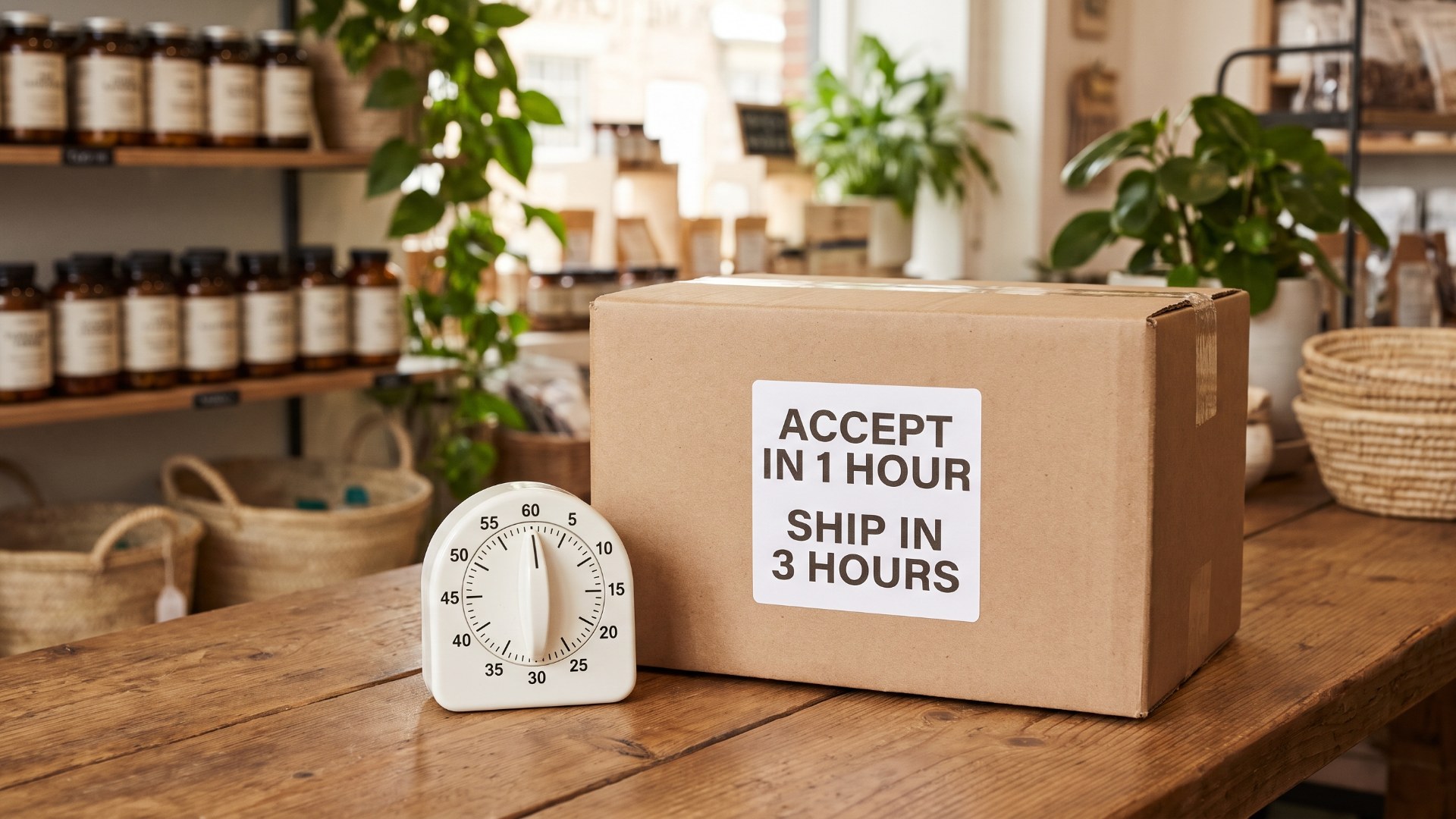

An order from IHR Plugin’s network will reach your store with a clock already running. The platform promises shoppers that a store will accept each order within one hour and ship it within three, and the person who keeps that promise is whoever happens to be behind your counter when the alert arrives.
IHR Plugin links the websites of independent health stores so that an online order is filled from the nearest shelf holding the product. It is now scheduled to go live in spring 2027, later than the September 2026 date given in earlier reports, and it has published its prices and service terms for the first time. Most coverage so far, ours included, has described what the network lets a store sell. With the terms public, the more useful question for an owner is what the network asks a store to do when it ships for someone else, and whether the pay covers the work. On small orders it does not, and the stores most likely to earn from it are the ones with unusual stock and a second pair of hands.
Disclosure: IHR Plugin and IHR Magazine share ownership.
What the network pays a store to ship
When a shopper buys on one member’s site and another member’s shelf fills the order, the retail margin is divided 60/40 in favour of the store that ships. The platform’s worked example is a $100 sale with $55 going to the brand’s wholesale price and $5 to the platform fee on the free Starter plan, which leaves $40 of margin. The shipping store’s share of that is $24. The customer pays shipping at checkout, and Stripe settles every party’s share within about 48 hours, so a fulfilling store is never chasing another retailer for money.
Expressed as a share of the sale, the shipping store keeps about 24 cents of every retail dollar on a product with that margin structure. That ratio is the number to carry into the next calculation, because network orders will rarely be $100.
The smallest order worth packing
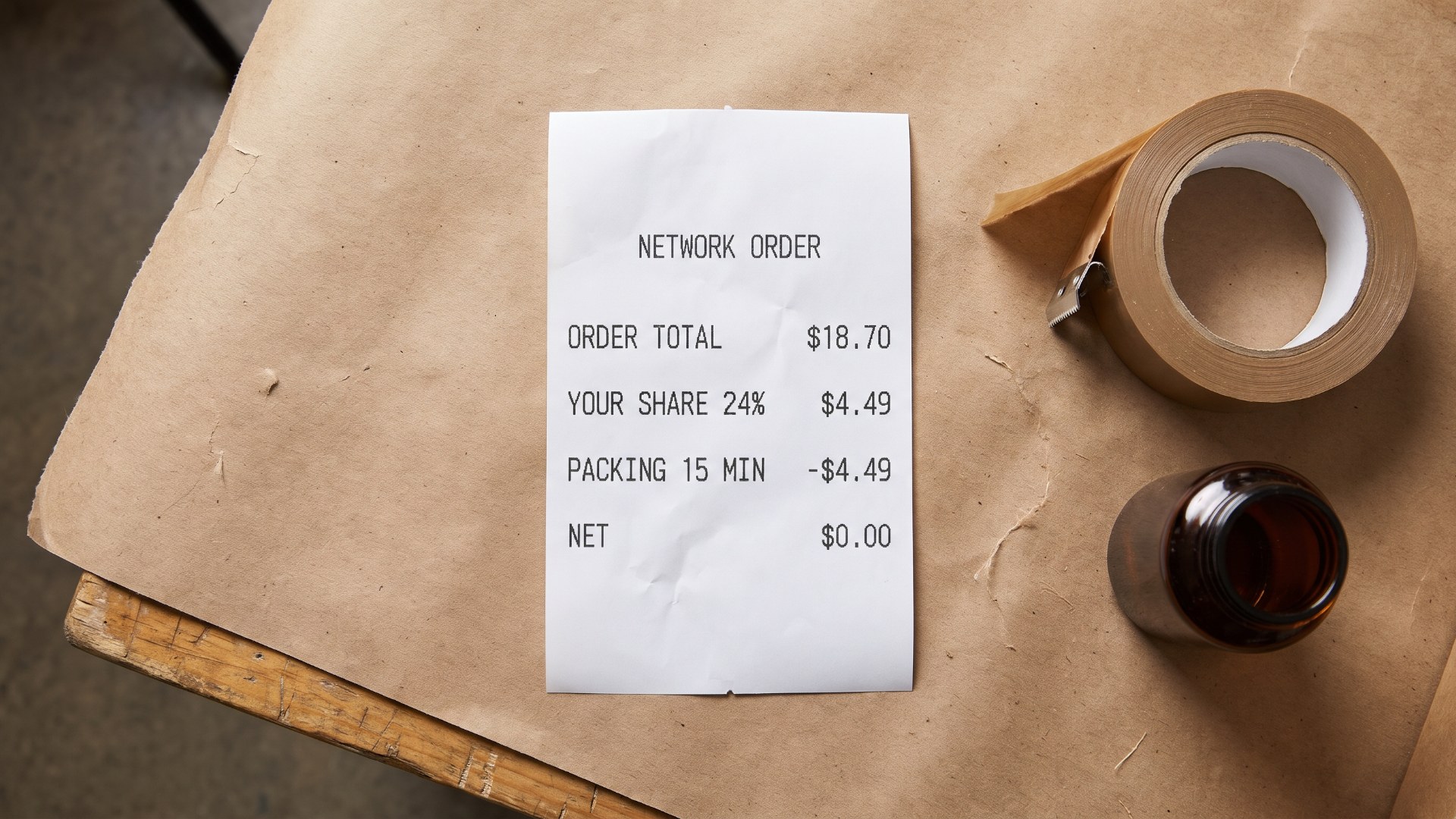
A fulfilment order costs labour before it earns anything. Someone has to accept it, pull the unit, pack it, print the label and hand it to the carrier. At Ontario’s general minimum wage of $17.95 an hour, which took effect on October 1, fifteen minutes of that work costs $4.49 in wages alone. Divide by the 24-cent share and the break-even order comes out at about $18.70 in retail value. Below that, a store paying minimum wage loses money on every order it ships for the network, before the box and the void fill are counted.
The threshold rises as margins thin. If a product leaves 30 per cent of the retail price as margin after wholesale and the platform fee, the shipping store keeps 18 cents on the dollar and the same fifteen minutes needs an order of about $25 to break even. A single tin of tea or a small bottle of vitamin D sits under both lines. A month of protein powder or a practitioner-grade multivitamin clears them easily.
These figures are illustrative. They use the platform’s own margin example and a fifteen-minute handling time, and they leave out packaging materials, payroll costs above the base wage and any card fees the store already carries. Owners should time ten real orders from accept to label and use their own number.
Why unusual stock earns more orders than a big floor

Routing follows a short published rule. The selling store’s own shelf is checked first, then the order goes to the store nearest the customer that has the product in stock, and stock is reserved at checkout so the last unit cannot sell twice. Only when no store can fill it does the order fall to the IHR distribution centre, a distributor or the manufacturer.
That rule rewards depth in the right places more than size. A best-selling magnesium or omega-3 will sit on many shelves in any city, so each order for it goes to whichever stocked store is closest to the shopper, and a member mostly ships those to its own neighbourhood. A line that no other member nearby carries behaves differently. Every network order for it in the region comes to the one store holding it, however far away the shopper lives. A specialist carrying a practitioner brand or a small regional label can expect more fulfilment orders from fewer products than a larger generalist with a familiar range.
The rule also exposes inventory accuracy. A unit reserved against a count that was wrong becomes an order the store accepted and cannot ship, with the shopper waiting on a service promise the store has already broken.
When shipping for the network does not pay
The one-hour window is easy for a store with two people on the floor and hard for one with a single clerk serving a lineup. The platform has not yet published what happens to an order a store fails to accept in time, and it has not explained the “priority fulfilment routing” listed on its US$399-a-month Professional plan. Until both are spelled out, a store on the free plan cannot know how often a contested order will reach it, or what a missed window costs.
For a single-staff store with mostly low-ticket online orders, that changes the advice. Connect during the free preview, list the catalogue, and treat fulfilment orders as occasional extra income that no budget depends on. A store with staff depth and lines its neighbours lack is in the opposite position, and it has the most to gain from being live on the first day.
Four things to measure before March 31
- How many minutes does it take us to accept, pick, pack and label one online order, timed over ten orders?
- In how many opening hours each week do we have two people on the floor?
- What is our average online order, and how much of it is margin after wholesale?
- Which lines do we carry that no other store within an hour’s drive stocks?
Frequently asked questions
When does IHR Plugin launch, and what happened to September 2026?
The company now gives spring 2027 as the launch, with live transactions starting then. Founding access closes on March 31, 2027, and stores can connect and use the platform in preview mode before that.
Does it cost anything to be a fulfilling store?
The Starter plan has no monthly fee and charges 5 per cent per fulfilled order. Growth costs US$149 a month at 4 per cent, Professional US$399 at 3 per cent, and Enterprise is priced individually.
Which carriers ship network orders?
The platform selects what it describes as the cheapest reliable carrier for each order from Canada Post, UPS, FedEx, Purolator and others.
Can the selling store discount a product I ship?
Not below the brand’s minimum advertised price. MAP monitoring is included on every plan, and brands choose which resellers may carry their lines.
What is checked before a product can be sold through the network?
The catalogue is verified against Natural Product Numbers, and the company says the platform aligns with PIPEDA, Quebec’s Law 25 and Canada’s Anti-Spam Legislation for customer data and marketing consent.
Who can join as a store?
Health food stores, pharmacies, grocers, practitioners and clinics. Brands and distributors join on the vendor side.
Sources: ihrplugin.com, accessed October 28, 2026; Ontario Ministry of Labour minimum wage announcement, effective October 1, 2026, as reported by Hicks Morley, April 1, 2026. IHR Plugin terms are as published before launch and may change.