



New research from inFlow Inventory measures an inventory AI gap that falls hardest on the independents least able to absorb the cost.
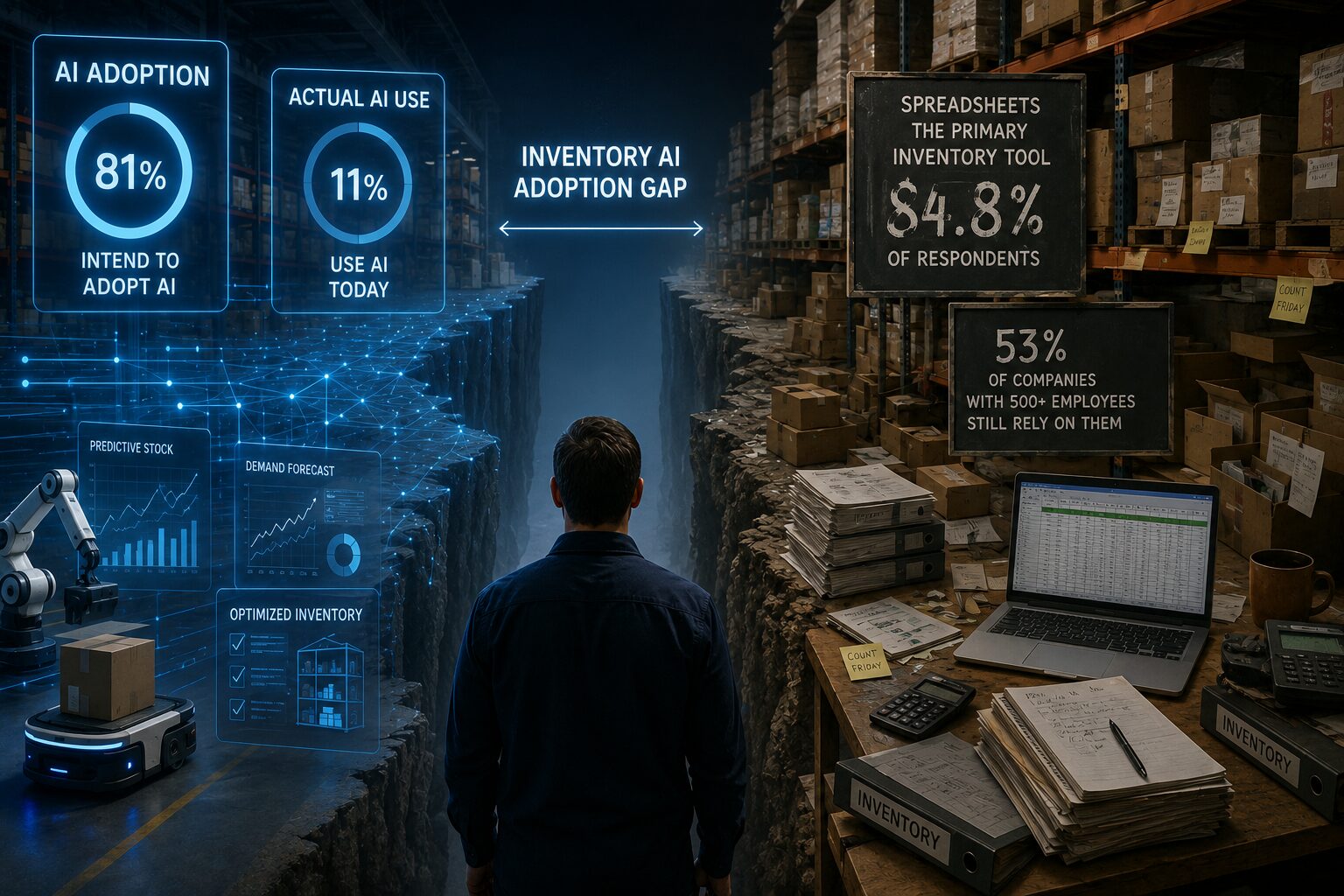
What is the inventory AI adoption gap? It is the distance between the 81 per cent of inventory operators who intend to adopt artificial intelligence and the 11 per cent who use it today. inFlow Inventory measured both figures in its State of Inventory Management 2026. The report blames access rather than appetite.
Toronto-based inFlow released the study on July 28. Research firm OvationMR conducted it in March 2026, surveying 400 full-time warehouse, inventory, supply chain and operations professionals across 33 industries.
The company then checked those answers against its own books. Roughly 4,000 structured observations from 293 inFlow customers, recorded between February and June, back up the survey results.
The headline finding is a mismatch. Intent to adopt AI runs at better than four in five operators. Actual use sits at one in nine.
Between those numbers lies the working reality of most stockrooms. Spreadsheets remain the primary inventory tool for 84.8 per cent of respondents. Among companies with more than 500 employees, 53 per cent still rely on them.
What operators want from inventory AI is narrower than what is being sold
The most useful detail here is not the adoption rate. It is the specification behind it.
Asked what they wanted AI to do, operators did not describe assistants or analytics layers. They described a buyer.
“Operators aren’t asking for general intelligence,” said Jared Plumb, lead content creator at inFlow. “They’re asking for a tool that tells them what to buy and when.”
Two capabilities came up repeatedly: demand forecasting and automated replenishment. One respondent asked for forecasting “that suggests purchase order quantities based on sales velocity.” That is an experienced buyer’s judgement, rendered in software.
Why the inventory AI barrier is structural
The specification also explains the gap. Forecasting accuracy depends on data volume, and one location’s sales history is a thin dataset.
Automated replenishment raises a second obstacle. It needs live connections between point of sale, stock records and supply. A business running on spreadsheets and email has none of them.
Larger operators buy their way past both problems. Smaller ones have generally judged the implementation cost higher than the visible pain. However, the report suggests that judgement rests on incomplete information.
The satisfaction figure and what sits underneath it
Consider what respondents said about their own systems. Fully 92 per cent described themselves as satisfied with their current approach to inventory.
The same respondents then listed the problems. Inventory accuracy needs the most improvement, said 49.5 per cent. Supplier reliability is the biggest challenge, said 52 per cent.
Stockouts tell a similar story. They occur at least monthly for 44 per cent of operators. Fewer than a quarter called themselves stockout-free or close to it.
The report’s authors read this as a benchmarking problem. Operators “anchor their satisfaction to the world they know rather than the performance they’re missing.”
That observation travels well to independent retail. An out-of-stock never appears in the accounts. Therefore the customer who wanted a missing product does not file a complaint or send an invoice, and the loss stays invisible.
Cost pressure sharpens the timing
Meanwhile, three cost lines are squeezing operators at once. Materials, freight and labour were each named as the sharpest pressure by roughly 22 to 23 per cent of respondents.
The trend is not easing. Around two-thirds reported increases in both freight and materials over the past year.
Priorities for the next twelve months follow from that. Technology integration ranked first at 60 per cent, narrowly ahead of inventory accuracy. Fulfilment speed came third at 50.8 per cent.
A second shift is running in parallel on the demand side, where AI agents are already shaping what shoppers consider. Retailers therefore face the same technology on both sides of the counter.
A network answer to the inventory AI gap
One response is to attack the problem collectively rather than site by site. That is the approach behind the IHR Plugin (ihrplugin.com), a decentralized health commerce platform built by the RGM Group for natural health food retailers.
Its premise is straightforward. Each participating store operates as a micro-warehouse, and stock stays visible across the network in real time.
The routing follows from that visibility. When a customer orders an item a store does not hold, the order moves to the closest node that does. That retailer ships it, the selling store keeps the customer, and both are credited.
Applied to the survey, the mechanism touches two findings directly. First, an out-of-stock becomes a routing decision rather than a lost sale. Second, dependence on any one supplier thins, because the network holds a wider pool of stock.
The catalogue effect addresses a third. A member store can present the network’s full assortment without warehousing it. Committing capital to a speculative line therefore stops being a precondition for offering the product.
What it asks of the retailer
Integration cost is the barrier the survey identifies most clearly, and it is the one the platform works hardest to avoid. Orders arrive through manual entry, Shopify or WooCommerce. Nothing needs rebuilding.
Suppliers keep commercial control. Brands can set minimum advertised prices and choose which retailers carry their goods. In short, that distinction separates a curated network from an open marketplace, where wider distribution is usually paid for in margin.
Two caveats matter. The platform is in beta ahead of a September 2026 launch, and the subscription is free. Its capabilities are previews of what the network is being built to deliver, not tools in general release.
Whether shared inventory proves a durable answer to the forecasting problem is a question the next year will settle. Still, the research itself makes a narrower point, and a harder one to argue with. The operators who most need better inventory intelligence hold the least data to build it from. Every month that gap stays open is billed quietly to the shelf.
Key takeaways
- inFlow Inventory surveyed 400 operators and found 81 per cent intend to adopt inventory AI while 11 per cent use it now.
- Operators want two specific capabilities: demand forecasting and automated replenishment.
- Spreadsheets remain the primary system for 84.8 per cent of respondents, including 53 per cent of large employers.
- Satisfaction sits at 92 per cent while 44 per cent stock out monthly, which the report attributes to benchmarking against familiar performance.
- Technology integration ranked as the top twelve-month priority at 60 per cent.
Frequently asked questions
How was the research conducted?
inFlow Inventory commissioned OvationMR to survey 400 full-time warehouse, inventory, supply chain and operations professionals in March 2026. The questionnaire ran to 38 questions across six topic areas and 33 industries. Results were then checked against roughly 4,000 structured observations from 293 inFlow customers.
Why is adoption so far behind stated intent?
The report points to structural barriers rather than reluctance. Useful inventory AI depends on data volume that single sites lack. Automated replenishment needs system integration that spreadsheets cannot support. Enterprise platforms solve both, but at costs smaller operators have judged prohibitive.
Is the 92 per cent satisfaction figure at odds with the findings?
The report treats it as a benchmarking effect. Operators judge their systems against performance they have experienced, not against outcomes they have never seen. Losses from stockouts and poor accuracy are real, but they are rarely itemized, so they seldom register as dissatisfaction.
How does a shared retail network change the stockout equation?
It makes stock visible beyond one location. On a network such as the IHR Plugin, an unavailable item routes to the nearest participating retailer holding it. The network absorbs the shortfall instead of the sale ending. Collective depth substitutes for individual forecasting accuracy.
What does the IHR Plugin cost, and when is it available?
The subscription is free. The platform is in beta ahead of a launch scheduled for September 2026. Its features are therefore best understood as previews of the network at launch, rather than functionality available to every retailer today.
Does a wider network put supplier pricing at risk?
Suppliers can set minimum advertised prices and decide which retailers carry their products. That control is the operative difference from an open marketplace. There, broader availability commonly triggers price competition that erodes margin across the channel.
The IHR Plugin (ihrplugin.com) is a decentralized health commerce platform for natural health food retailers, built by the RGM Group. It is currently in beta, with a full launch scheduled for September 2026.