



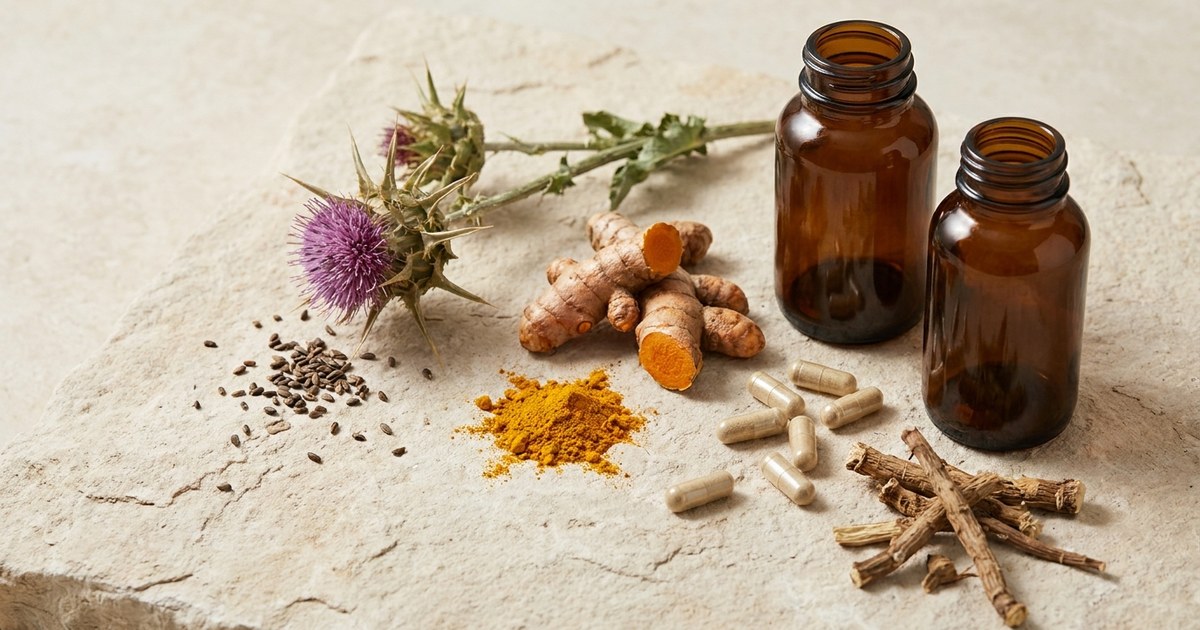
Liver support has quietly become one of the most active corners of the supplement aisle. Milk thistle, turmeric and dandelion root — three botanicals that have circulated in traditional use for generations — are being repackaged into “liver wellness” formulas and marketed to consumers who want to be proactive about metabolism, digestion and antioxidant balance. The category is growing. The question for Canadian natural health retailers isn’t whether to stock it, but how to merchandise it without inheriting the compliance and credibility risk that trails a fast-moving trend.
This week’s promotion of PureHealth Research’s milk thistle–turmeric–dandelion liver formula is a useful example of the category’s playbook — and of exactly where retailers need to apply their own judgment rather than the marketing copy’s.
Why liver wellness is trending
The consumer logic is easy to follow. The liver sits at the centre of metabolism, nutrient processing and the body’s filtration processes, so “supporting” it maps neatly onto the broader wellness impulse to optimize everything. That intuitive appeal, plus a post-pandemic appetite for preventive self-care and strong social media interest in “detox” and metabolic health, has pushed liver support from a practitioner niche into mainstream shelf demand.
There is also a real demographic tailwind. Rates of metabolic dysfunction–associated steatotic liver disease (the condition formerly called non-alcoholic fatty liver disease) have climbed alongside obesity and type-2 diabetes, and the GLP-1 era has made metabolic health a mainstream conversation. Consumers are primed to think about their liver in a way they weren’t a decade ago — and they are shopping accordingly.
The three botanicals, read honestly
For a trade audience, the useful move is to separate the traditional-use story from the clinical-evidence story, because they are not the same thing.
Milk thistle (silymarin) is the most-studied of the three. Its hepatoprotective mechanisms — antioxidant activity and support of hepatocyte membranes — are biologically plausible and backed by a sizeable, if uneven, body of research. Reviews have found the human clinical evidence for hard outcomes to be mixed and often limited by study quality, which is why cautious formulators talk about “maintaining healthy liver function” rather than treating disease.
Turmeric (curcumin) has genuine antioxidant and anti-inflammatory data, but two caveats belong on every retailer’s radar. Bioavailability is poor without a delivery system, so the form matters as much as the dose. And high-dose turmeric and curcumin extracts have been linked to rare cases of liver injury — the ingredient marketed for liver support has itself been flagged in hepatotoxicity reports. That is not a reason to avoid it, but it is a reason to take formulation and dosing seriously.
Dandelion root carries the thinnest clinical file of the three. Its inclusion rests largely on traditional use as a digestive bitter and mild diuretic. That is a legitimate positioning — provided the claim stays in the traditional-use lane and doesn’t drift toward implied disease treatment.
The pattern across all three is consistent: plausible mechanisms and long traditional use, paired with human-outcome evidence that is real but modest. Honest merchandising lives in that gap.
The Canadian compliance line
This is where the category gets genuinely different north of the border, and where imported marketing copy can quietly create liability.
In Canada, liver supplements are Natural Health Products regulated by Health Canada, and every claim on the label must be backed by an authorised Natural Product Number. That system is stricter than the structure/function conventions that govern much U.S. marketing. Language that reads as compliant in a U.S. press release — even carefully hedged phrasing about “supporting healthy liver function” — is only permissible in Canada if it matches the claim authorised on that product’s NPN.
The practical implications for a Canadian retailer are concrete. Any liver product on the shelf should carry a valid NPN, and staff-facing and shelf-facing messaging should track the licensed claim rather than the brand’s global copy. “Detox,” “cleanse” and anything implying treatment of a diagnosed liver condition are the phrases most likely to attract regulatory attention and erode trust. Milk thistle and turmeric can also interact with medications metabolised by the liver, which makes them a candidate for a pharmacist conversation in any integrated pharmacy-wellness setting — a service touchpoint independents can turn into a differentiator.
The retail opportunity — and how to earn it
None of the above argues against the category. It argues for owning it more credibly than the marketing wave that’s driving it.
Liver wellness is a natural basket-builder, sitting adjacent to digestive health, metabolic support and the GLP-1-companion products already pulling traffic. The retailers who win it will be the ones who curate on evidence and form — favouring standardised extracts, sensible dosing and bioavailable curcumin over the cheapest blend that lists the right three botanicals. Simple shelf education that explains what these ingredients do and don’t do turns a trend purchase into a repeat one, and positions the store as the trustworthy filter in a category thick with hype.
The demand is real and rising. So is the regulatory exposure and the noise. The opportunity for the natural health channel is to be the place where a consumer gets an honest version of the liver-wellness story — because in a category built on the promise of “supporting” the body’s filter, trust is the product that actually moves.
This is an independent editorial analysis by IHR Magazine. It references PureHealth Research’s liver formula as one publicly promoted example of the category and is not an endorsement. Nothing here is medical advice or a product claim; retailers should verify NPN status and licensed claims for any product they stock.
Frequently asked questions
Do liver wellness supplements actually work?
The main botanicals — milk thistle, turmeric and dandelion root — have plausible antioxidant and digestive mechanisms and a long history of traditional use, but human clinical evidence for hard outcomes is mixed and often limited by study quality. Most are positioned to help maintain healthy liver function, not to treat liver disease.
Are liver supplements regulated in Canada?
Yes. They are Natural Health Products regulated by Health Canada, and every product must carry an authorised Natural Product Number (NPN) with claims that match what is licensed. Marketing language from other markets is not automatically compliant in Canada.
Is turmeric safe for liver support?
Turmeric and curcumin have antioxidant data, but bioavailability is poor without a delivery system, and high-dose extracts have been linked to rare cases of liver injury. Form and dosing matter, and consumers on medication should consult a pharmacist or practitioner.
What should retailers look for when stocking liver wellness products?
A valid NPN, licensed claims that match shelf messaging, standardised extracts with sensible dosing and bioavailable curcumin forms, and awareness of potential interactions with liver-metabolised medications.